
How to Estimate Parking Lot Sealcoating Costs
Last Updated: November 27, 2026
Quick Summary
Parking lot sealcoating cost is usually priced per square foot, then adjusted by fixed charges like mobilization and traffic control. Sealer type, number of coats, surface condition and application method all move the total. Compare itemized quotes, not single rates, to judge a fair price.
- Contractors usually price sealcoating by the square foot, then add fixed mobilization and traffic control charges.
- Two coats usually cost more than one but last longer.
- Small lots often carry a higher effective rate per square foot because fixed charges spread over less area.
- Crack filling, patching and striping are separate line items that can be missing from a low bid.
- Ask every bidder to fill in the same worksheet so totals can be compared line by line.
Table of Contents
- What Parking Lot Sealcoating Costs Per Square Foot
- Total Project Cost by Parking Lot Size
- Factors That Change Sealcoating Quotes
- Sealcoating Cost Calculator: Build an Itemized Estimate
- Crack Filling, Striping and Other Add-On Costs
- How Often to Seal Asphalt and Why Timing Affects Cost
- Getting an Accurate Quote for Your Commercial Lot
- Frequently Asked Questions
Sealcoating a commercial parking lot is one of the cheapest ways to protect asphalt, but quotes for the same job can vary widely. Property managers in Houston who understand how pricing is built can compare bids on equal footing. This guide explains how to estimate parking lot sealcoating costs, which factors move the number, and how to read a quote before you sign.
Sealcoating is a protective surface treatment applied over asphalt to slow oxidation, water penetration and UV damage.
What Parking Lot Sealcoating Costs Per Square Foot
Contractors usually price sealcoating by the square foot, then add fixed charges for mobilization, traffic control and minimum job size. Per-square-foot rates reflect materials, labor and equipment across the whole area. They are a starting point, not a final number.
Several inputs drive the per-square-foot figure:
- Sealer type: Asphalt-emulsion sealers are the common choice for commercial lots. Coal tar sealers are restricted in some areas, so check local rules before specifying one.
- Number of coats: Two coats usually cost more than one but last longer.
- Surface condition: A lot that needs cleaning, crack filling or patching before sealing costs more to prepare.
- Application method: Spray application and squeegee application have different labor and production rates.
Ask every bidder to state the square footage used, the sealer product and the number of coats.
Total Project Cost by Parking Lot Size
Total cost scales with lot size, but not in a straight line. Mobilization, traffic control, striping and minimum job charges are largely fixed, so a small lot often carries a higher effective rate per square foot than a large one. Large lots may earn better unit pricing, but site access, phasing and the amount of prep work can offset that advantage.
A reliable way to build a total is to separate the job into fixed charges and area-driven charges, then add the add-on line items. The worksheet below shows how the pieces combine. Fill in your own measured quantities and quoted rates; the structure is what makes bids comparable.
Fixed charges (do not scale with area)
- Mobilization and equipment delivery
- Traffic control and signage
- Minimum job charge, if the lot is small
- Permits or notification requirements, if any
Area-driven charges (scale with square footage)
- Cleaning and surface preparation, priced per square foot
- Sealer material, priced per square foot per coat
- Labor and application, priced per square foot per coat
- Number of coats (one versus two)
Add-on line items (priced by quantity)
- Crack filling, priced by linear foot of routed and filled crack
- Patching, priced by square foot of failed area
- Striping and accessible parking marking, priced per stall or per linear foot of line
- Fire lane and directional markings, priced per marking
To see how the structure behaves, work through three common lot sizes using placeholder rates from your own bids. A small retail or office lot of about 10,000 square feet typically carries a higher effective rate per square foot because fixed charges are spread over less area. A mid-size lot of about 50,000 square feet spreads mobilization and traffic control across more area, so the effective rate usually drops. A large industrial or shopping-center lot of 150,000 square feet or more may qualify for better unit pricing, but phased work, multiple entrances and heavy prep can pull the effective rate back up.
A common pattern is that the fixed charges are a larger share of a small lot’s total than most owners expect. Ask each bidder to show fixed charges separately so you can see whether a low per-square-foot rate is real or just a different allocation of the same money.
A quote that gives only a single per-square-foot rate and a total may not show whether mobilization, preparation, crack filling and striping are included.
Use the calculator section below to build the number line by line, and ask every bidder to fill in the same worksheet so the totals can be compared on equal footing.
Factors That Change Sealcoating Quotes
Two quotes for the same lot can differ because the bidders assumed different scopes. Check these before comparing totals:
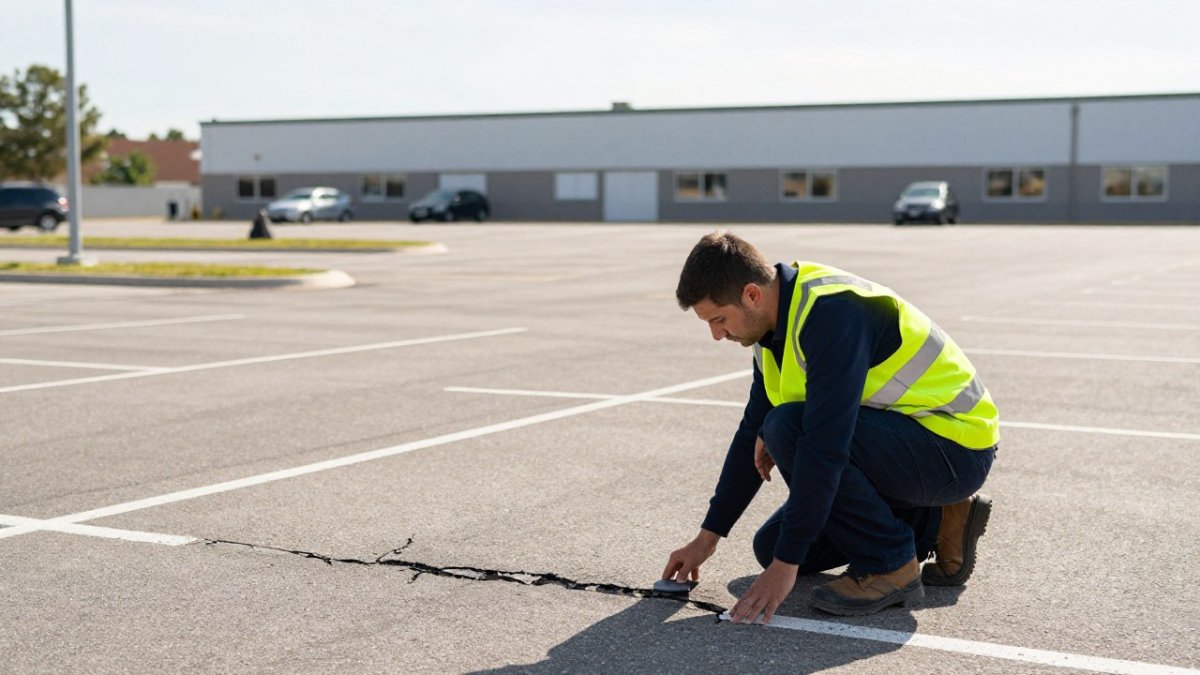
- Lot condition: Heavy alligator cracking, oil stains and standing water all add prep time.
- Access and phasing: Lots that must stay open to tenants or delivery trucks may need work in sections, which raises labor cost.
- Operating hours: After-hours or weekend work can carry a premium. Ask whether the bid assumes daytime work.
- Drying and curing: Sealer needs time to cure before traffic returns. Confirm the bid includes a realistic closure window.
- Striping and marking: Restriping, accessible parking symbols and fire lane markings are often priced separately from sealing.
Quotes that differ mainly in preparation scope are not equal. A lower bid that skips crack filling may cost more within a year. See which repair and site conditions push a commercial lot quote up or down for more on how these scope differences play out.
Sealcoating Cost Calculator: Build an Itemized Estimate
Most sealcoating quotes are not directly comparable because bidders assume different scopes and specifications behind the same square-foot rate. The worksheet below is built to expose those differences. Ask every bidder to fill in the same worksheet with measured quantities and unit prices, then compare line by line before comparing totals.
Step 1, Measure the area. Record total paved area in square feet, excluding landscaped islands, curbs and non-paved surfaces. Note whether the bidder measured the same area you did.
Step 2, Specify the sealer and coat count. State the sealer product and the number of coats. One coat and two coats are different products at different prices, and a two-coat job is not a one-coat job with a discount.
Step 3, Price the area-driven work. Multiply area by the quoted per-square-foot rate for cleaning, material and application. Keep material and labor separate if the bidder will show them; if not, ask for the combined rate per coat.
Step 4, Add fixed charges. Mobilization, traffic control and any minimum job charge do not scale with area. List them separately.
Step 5, Add preparation and repairs by quantity. Crack filling is priced by linear foot of crack actually routed and filled. Patching is priced by square foot of failed area. Ask for the measured quantities, not a lump sum.
Step 6, Add striping and marking by quantity. Restriping, accessible parking symbols, access aisles, fire lanes and directional arrows are priced per stall, per linear foot or per marking. Keep them visible on the quote.
Step 7, Reconcile the total. Confirm the total equals the sum of every line item. A total that does not reconcile is a warning sign.
Why quoted square-foot rates differ
Two bidders can quote the same lot at different per-square-foot rates and both be correct, because the rate means different things. The main specification differences are:
- Coat count: One coat versus two changes both material and labor.
- Application method: Spray application and squeegee application have different production rates and different material consumption.
- Sealer formulation: Asphalt-emulsion sealers are the common commercial choice, but additive packages and solids content vary by product. Coal tar sealers are restricted in some areas, so confirm local rules before specifying one.
- Surface preparation: Power blowing, degreasing oil spots and priming are not always included.
- Included repairs: Crack filling and patching may be in scope or excluded.
- Curing and traffic control: A realistic closure window and traffic control plan cost money and should appear on the quote.
A worked example of the reconciliation
Suppose a bidder quotes a per-square-foot rate for two coats, a mobilization charge, a crack-filling quantity in linear feet, and a striping quantity in stalls. Add those four line items and compare the sum to the quoted total. Then do the same for the next bidder. If the totals differ, the line items will show whether the difference is area, coat count, preparation, repairs or striping. That is the comparison that matters, and it is the one a single per-square-foot rate cannot support.
A bid that excludes crack filling or preparation can leave you paying for water damage later. Ask the contractor to confirm in writing which cracks and which preparation steps are included.
Use this worksheet for every bidder. A bid that lists every line item makes it easier to see where the numbers differ.
The steps below follow the worksheet, so each bidder’s quote can be checked line by line against the same measured quantities.
| Step | What to do | Key check |
|---|---|---|
| 1. Measure the area | Record paved square feet, excluding islands, curbs and unpaved surfaces | Same area used by every bidder |
| 2. Specify sealer and coats | State the product and the number of coats | One coat and two coats are different prices |
| 3. Price area-driven work | Multiply area by the per-square-foot rate for cleaning, material and application | Keep material and labor separate if shown |
| 4. Add fixed charges | List mobilization, traffic control and any minimum job charge | These do not scale with area |
| 5. Add prep and repairs | Price crack filling by linear foot and patching by square foot | Ask for measured quantities, not a lump sum |
| 6. Add striping and marking | Price restriping and fire lane markings per stall, foot or marking | Keep these visible on the quote |
| 7. Reconcile the total | Confirm the total equals the sum of every line item | A total that does not reconcile is a warning sign |
Crack Filling, Striping and Other Add-On Costs
Crack filling is the most common add-on to a sealcoating project. Cracks left open let water reach the base, so filling them before sealing usually makes sense. Price crack filling by linear foot or by job, and ask for the crack length the contractor measured.
Striping and accessible parking marking are separate line items. Lots must meet accessibility marking requirements, and restriping often accompanies a seal job. Keep these costs visible on the quote rather than buried in a lump sum.
A bid that excludes crack filling can leave you paying for water damage later. Ask the contractor to confirm in writing which cracks are included.
How Often to Seal Asphalt and Why Timing Affects Cost
Most commercial lots benefit from resealing every few years, depending on traffic, climate and sun exposure. Sealing too late means the surface has already oxidized and cracked, which turns a maintenance job into a repair job with a higher price.
Scheduling also affects cost. Contractors often have more availability and better rates during slower seasons, but the weather must allow sealer to cure. Plan the work before cracks spread and before tenants or events require a closed lot.
Getting an Accurate Quote for Your Commercial Lot
Start by measuring the lot and documenting its condition with photos. Share the measurements, your access constraints and your operating hours with each bidder so every quote reflects the same scope.
Request an itemized proposal that shows area, sealer and coat count, preparation, crack filling, striping and mobilization separately. Compare the scopes first, then the totals. A reliable contractor will explain every line.
For a site-specific estimate, request a quote through the All-Tech Asphalt Paving, LLC. website.
ASTM standards for asphalt sealer materials
American Society of Civil Engineers guidance on pavement maintenance
Federal Highway Administration pavement preservation resources
Frequently Asked Questions
How much does parking lot sealcoating cost per square foot?
Pricing depends on lot size, surface condition, the number of coats, and how much prep the surface needs. Per-square-foot quotes vary by contractor and region, so the most reliable way to compare is to request itemized bids that state the same scope: cleaning, crack filling, number of coats, and striping. Ask each provider to list mobilization and any job minimums separately. For a current figure tied to your lot dimensions and condition, request a site-specific quote from All-Tech Asphalt Paving, LLC. through its website.
How often does an asphalt parking lot need to be sealed?
Most commercial asphalt lots are sealed on a recurring schedule, often every two to three years, though the right interval depends on traffic volume, sun exposure, climate, and the condition of the surface. Lots with heavy vehicle traffic or significant UV exposure may need attention sooner. Sealing too frequently adds cost without benefit, while waiting too long allows cracks and oxidation to develop, which increases repair expenses. A site assessment helps set the right interval for your property.
Does parking lot sealcoating include crack filling and line striping?
Standard sealcoating covers cleaning and applying sealer to the pavement surface. Crack filling, pothole repair, and line striping are usually separate line items because they involve different materials and labor. Some contractors bundle them into a package, while others price each service individually. When comparing bids, confirm whether crack filling and striping are included, and ask for the cost of each so you can see exactly what you are paying for.
How long should a parking lot stay closed after sealcoating?
Sealcoat generally needs several hours to become traffic-ready in mild weather, though full curing can take longer, and cooler or humid conditions extend drying time. Most contractors recommend keeping vehicles off the surface until the sealer has cured enough to resist tracking. Scheduling work during low-traffic periods, such as evenings or weekends, reduces operational disruption. Ask your contractor for an estimated closure window and a plan for weather delays before work begins.
