29 Nov 2026

How Long Does Asphalt Paving Take: Timeline and Curing Guide

Last Updated: November 28, 2026

Quick Summary

Most asphalt paving takes one to three days of installation, but the full timeline runs longer once site prep and curing are counted. Plan for two clocks: crew time on site, and the time the new surface needs before normal use. Full cure takes six to twelve months for heavy traffic.

  • Driveway paving typically involves one to two days of crew work.
  • Parking lot or commercial lot paving takes two to five days depending on size.
  • New asphalt is usually walkable within 24 to 48 hours.
  • Passenger cars can typically use fresh asphalt after 48 to 72 hours.
  • Base preparation is the phase that most often stretches a paving schedule.
How long will your paving project really take?All-Tech Asphalt Paving plans asphalt and concrete projects with clear timelines and reliable crews.

Get a Paving Quote

Table of Contents

How Long Does Asphalt Paving Take: The Short Answer

Most asphalt paving jobs take one to three days of installation, but the full timeline runs longer once site prep and curing are counted. Plan for two clocks: crew time on site, and the time the new surface needs before normal use.

  • Driveway paving: one to two days of crew work
  • Parking lot or commercial lot: two to five days, depending on size
  • Full cure: six to twelve months for heavy traffic

The gap between “the crew left” and “the lot is fully cured” is where most people get surprised. Below, we break down each phase so you can plan access and parking.

Asphalt Paving Project Timeline: From Site Prep to Final Rolling

Asphalt paving is a phased process, not a single day of work. The five stages below depend on each other; durations are typical for a residential driveway or small commercial lot.

  1. Site preparation and grading (roughly 2 to 6 hours). Crews clear the area, strip vegetation, shape the subgrade, and confirm drainage slopes. Full excavation of the old surface adds half a day or more.
  2. Base preparation (roughly 3 to 8 hours). An aggregate base is spread in lifts and compacted to a firm, even layer. Each lift must be compacted before the next goes down, which is why base work is the phase most likely to stretch.
  3. Hot-mix asphalt placement (roughly 2 to 5 hours). The crew lays the mix with a paver at the right temperature and thickness, moving only as fast as dump trucks deliver hot mix.
  4. Compaction (roughly 1 to 3 hours). Rollers press the surface while it is still hot, sealing it tight. Breakdown rolling happens immediately behind the paver, then intermediate and finish rolling follow.
  5. Final rolling and cleanup (roughly 1 to 2 hours). Crews finish edges, check grade, and clear debris.
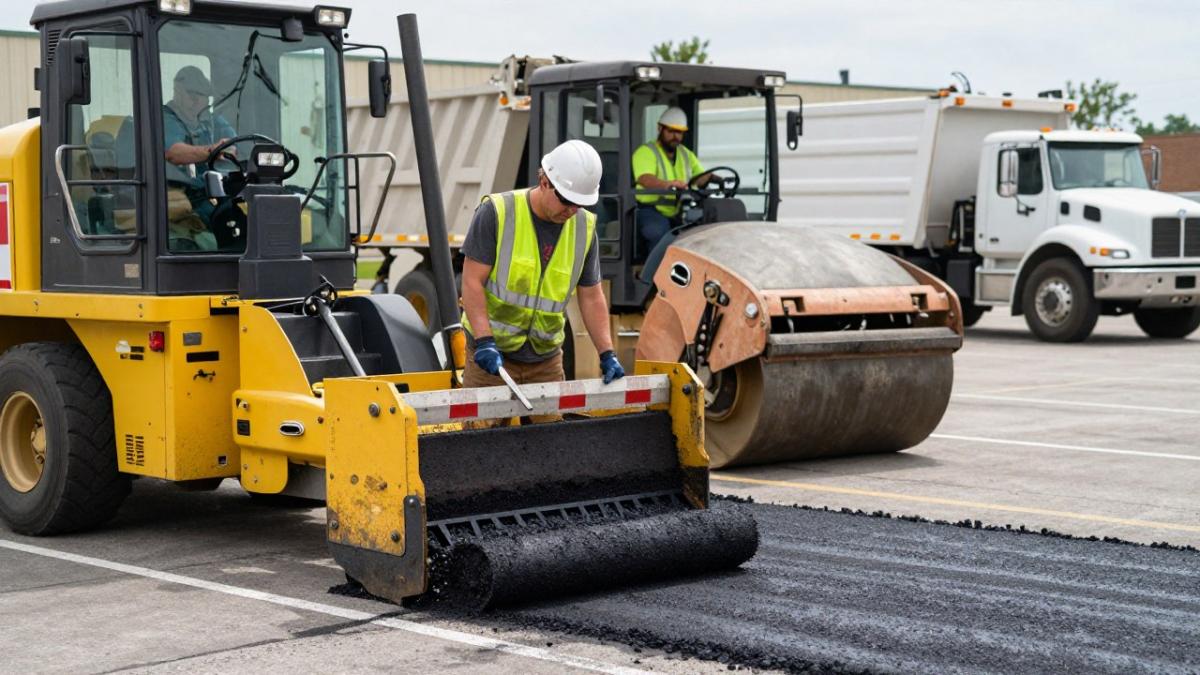
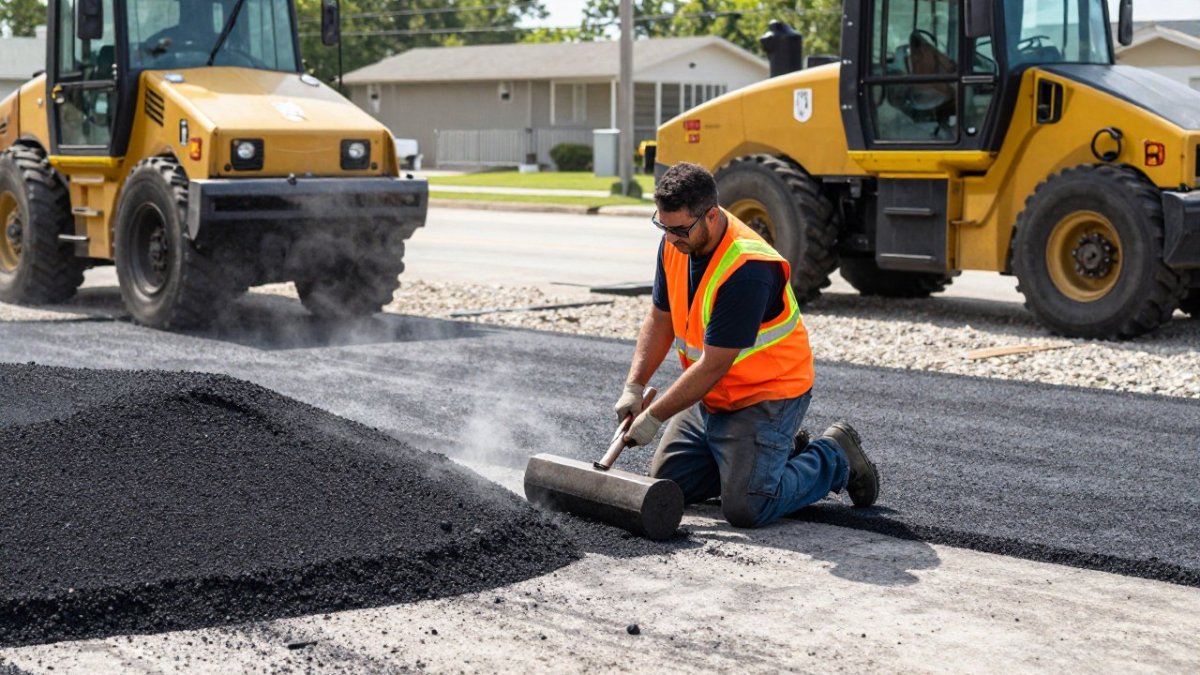
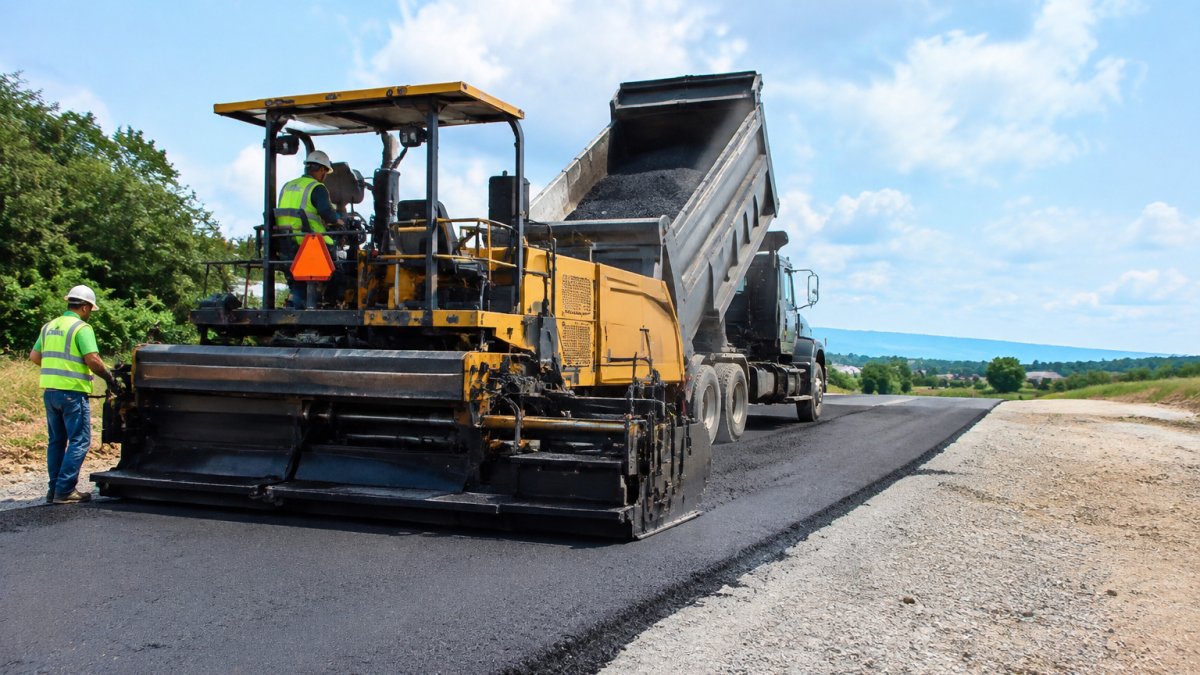
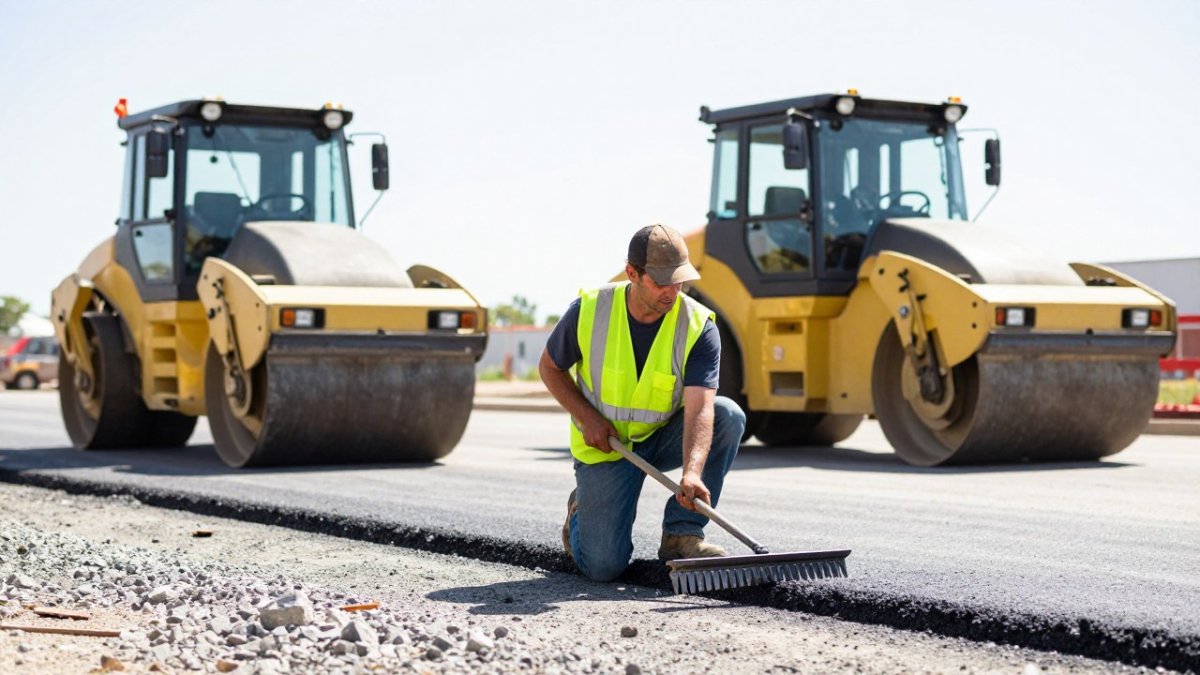
Paving crew operating a yellow paver and steam roller during an asphalt paving project on a parking lot

What can delay a paving project. Most schedule slippage comes from a short list of causes:

  • Excavation and base repairs. Removing failed pavement or replacing soft subgrade adds hours to days. A base that pumps or deflects under a loaded truck is not ready for asphalt.
  • Drainage work. Adding or re-grading a swale, catch basin, or French drain must happen before paving, and it is often the longest single add-on.
  • Weather. Rain on an unprepared base or fresh asphalt stops work. Hot-mix plants also slow production in cold weather because mix cools too fast to compact.
  • Material delivery. A plant backlog or truck breakdown idles the paver.
  • Site complexity. Tight access, steep grades, and utility covers slow every phase.

Base preparation is the phase that most often stretches a schedule. For a detailed schedule, see our guide on how to plan an asphalt paving project timeline. Property managers worried about slippage should read our tips on avoiding paving contractor project delays. Commercial readers can go deeper on how to prepare a commercial lot for asphalt paving.

Typical durations of asphalt paving project phases

Site preparation and grading 2 to 6 hours
Base preparation 3 to 8 hours
Hot-mix asphalt placement 2 to 5 hours
Compaction 1 to 3 hours
Final rolling and cleanup 1 to 2 hours

How Long Does It Take to Pave a Driveway?

A typical residential asphalt driveway takes one to two days of crew work, plus a few days of site prep before that. Project size drives the range, and the table below shows how scope changes the estimate.

Project scope Crew time (paving) Total timeline including prep
Small driveway (under about 500 sq ft), easy access Half a day to 1 day 2 to 3 days
Standard driveway (about 500 to 1,000 sq ft) 1 to 2 days 3 to 4 days
Large driveway (over about 1,000 sq ft) or extra base work 2 to 3 days 4 to 6 days
Small parking area or commercial lot 2 to 5 days 1 to 2 weeks

Thickness matters too: a thicker asphalt mix takes longer to place and compact, and full excavation of the old surface adds a day before paving starts. Access is the other wildcard, a narrow, gated, or steep approach slows every load.

Homeowner preparation and access checklist. The crew’s clock starts when the site is ready, so handle these before day one:

  • Move all vehicles, trailers, and equipment off the driveway and out of the work area.
  • Clear the site of basketball hoops, planters, trash cans, and anything the crew would have to move.
  • Arrange alternate parking and access for the curing window, not just the paving days.
  • Trim low branches and confirm gate widths so trucks and the roller can get in.
  • Mark irrigation heads, sprinkler lines, and any private utilities in the work area.
  • Keep children and pets off the site during grading and paving.

How to get a project-specific estimate. No article can give an exact duration, because the answer depends on your site. When you call a contractor, have these details ready: the driveway’s length and width, the existing surface (gravel, old asphalt, or concrete), its condition, whether drainage is a problem, and how much base work you expect. A contractor who asks those questions is building a real schedule; one who quotes a flat number without them is guessing.

For a step-by-step walkthrough of the installation itself, see our guide on how to install an asphalt driveway.

How Soon Can You Drive on Fresh Asphalt?

New asphalt is usually walkable within 24 to 48 hours and open to passenger cars after 48 to 72 hours. Full cure takes far longer, often six to twelve months.

“Dry” and “cured” are not the same thing. Asphalt cools and hardens quickly, but the surface keeps curing for months as oils work out of the mix.

During the first weeks, watch for:

  • Tire marks from turning or braking sharply
  • Surface scuffs from heavy vehicles or equipment
  • Debris left sitting on soft spots

Keep heavy vehicles off fresh asphalt longer than passenger cars. Open to light traffic first, then trucks once the surface has set. Once you know your timeline, the next step is a professional quote, and our guide on how to get a professional asphalt driveway quote explains what to ask.


Planning around fresh asphalt comes down to one thing: knowing your timeline before the crew arrives. Request a quote from All-Tech Asphalt Paving, LLC. to put a firm timeline on your next paving project.

Frequently Asked Questions

How soon can you walk on newly paved asphalt?

Most asphalt paving crews allow foot traffic on a fresh surface once it has cooled enough to hold firm, usually within 24 to 48 hours. That window depends on air temperature, sun exposure, and pavement thickness. In hot weather, the surface stays soft longer, so keep foot traffic off until the contractor confirms it is safe. For a home or office complex, plan alternate walking routes for at least a day after the crew leaves.

Can you drive on fresh asphalt right after paving?

No. Passenger cars should stay off new asphalt for at least 24 to 72 hours, and heavier vehicles need more time. Fresh asphalt needs to cool and set before it can handle tire loads without marking or rutting. Turning and braking put the most stress on a new surface, so avoid both during the first few days. Ask your paving contractor for a specific access date based on the mix and weather.

How long does asphalt take to fully cure?

Asphalt cools within hours but keeps curing for six to twelve months. During that period the surface hardens and darkens, and it stays more vulnerable to tire marks, turning scuffs, and heavy loads. Keep heavy vehicles off the pavement and avoid sharp turning or braking in the first months. Full cure depends on weather conditions, pavement thickness, and traffic, so follow your contractor’s guidance on when to resume normal use.

28 Nov 2026

How to Estimate Parking Lot Sealcoating Costs

Last Updated: November 27, 2026

Quick Summary

Parking lot sealcoating cost is usually priced per square foot, then adjusted by fixed charges like mobilization and traffic control. Sealer type, number of coats, surface condition and application method all move the total. Compare itemized quotes, not single rates, to judge a fair price.

  • Contractors usually price sealcoating by the square foot, then add fixed mobilization and traffic control charges.
  • Two coats usually cost more than one but last longer.
  • Small lots often carry a higher effective rate per square foot because fixed charges spread over less area.
  • Crack filling, patching and striping are separate line items that can be missing from a low bid.
  • Ask every bidder to fill in the same worksheet so totals can be compared line by line.
Want an itemized sealcoating estimate?All-Tech Asphalt Paving, LLC. provides site-specific quotes for commercial parking lots in Houston.

Get a Quote

Table of Contents

Sealcoating a commercial parking lot is one of the cheapest ways to protect asphalt, but quotes for the same job can vary widely. Property managers in Houston who understand how pricing is built can compare bids on equal footing. This guide explains how to estimate parking lot sealcoating costs, which factors move the number, and how to read a quote before you sign.

Sealcoating is a protective surface treatment applied over asphalt to slow oxidation, water penetration and UV damage.

What Parking Lot Sealcoating Costs Per Square Foot

Contractors usually price sealcoating by the square foot, then add fixed charges for mobilization, traffic control and minimum job size. Per-square-foot rates reflect materials, labor and equipment across the whole area. They are a starting point, not a final number.

Several inputs drive the per-square-foot figure:

  • Sealer type: Asphalt-emulsion sealers are the common choice for commercial lots. Coal tar sealers are restricted in some areas, so check local rules before specifying one.
  • Number of coats: Two coats usually cost more than one but last longer.
  • Surface condition: A lot that needs cleaning, crack filling or patching before sealing costs more to prepare.
  • Application method: Spray application and squeegee application have different labor and production rates.

Ask every bidder to state the square footage used, the sealer product and the number of coats.

Total Project Cost by Parking Lot Size

Total cost scales with lot size, but not in a straight line. Mobilization, traffic control, striping and minimum job charges are largely fixed, so a small lot often carries a higher effective rate per square foot than a large one. Large lots may earn better unit pricing, but site access, phasing and the amount of prep work can offset that advantage.

A reliable way to build a total is to separate the job into fixed charges and area-driven charges, then add the add-on line items. The worksheet below shows how the pieces combine. Fill in your own measured quantities and quoted rates; the structure is what makes bids comparable.

Fixed charges (do not scale with area)

  • Mobilization and equipment delivery
  • Traffic control and signage
  • Minimum job charge, if the lot is small
  • Permits or notification requirements, if any

Area-driven charges (scale with square footage)

  • Cleaning and surface preparation, priced per square foot
  • Sealer material, priced per square foot per coat
  • Labor and application, priced per square foot per coat
  • Number of coats (one versus two)

Add-on line items (priced by quantity)

  • Crack filling, priced by linear foot of routed and filled crack
  • Patching, priced by square foot of failed area
  • Striping and accessible parking marking, priced per stall or per linear foot of line
  • Fire lane and directional markings, priced per marking

To see how the structure behaves, work through three common lot sizes using placeholder rates from your own bids. A small retail or office lot of about 10,000 square feet typically carries a higher effective rate per square foot because fixed charges are spread over less area. A mid-size lot of about 50,000 square feet spreads mobilization and traffic control across more area, so the effective rate usually drops. A large industrial or shopping-center lot of 150,000 square feet or more may qualify for better unit pricing, but phased work, multiple entrances and heavy prep can pull the effective rate back up.

A common pattern is that the fixed charges are a larger share of a small lot’s total than most owners expect. Ask each bidder to show fixed charges separately so you can see whether a low per-square-foot rate is real or just a different allocation of the same money.

A quote that gives only a single per-square-foot rate and a total may not show whether mobilization, preparation, crack filling and striping are included.

Use the calculator section below to build the number line by line, and ask every bidder to fill in the same worksheet so the totals can be compared on equal footing.

Factors That Change Sealcoating Quotes

Two quotes for the same lot can differ because the bidders assumed different scopes. Check these before comparing totals:

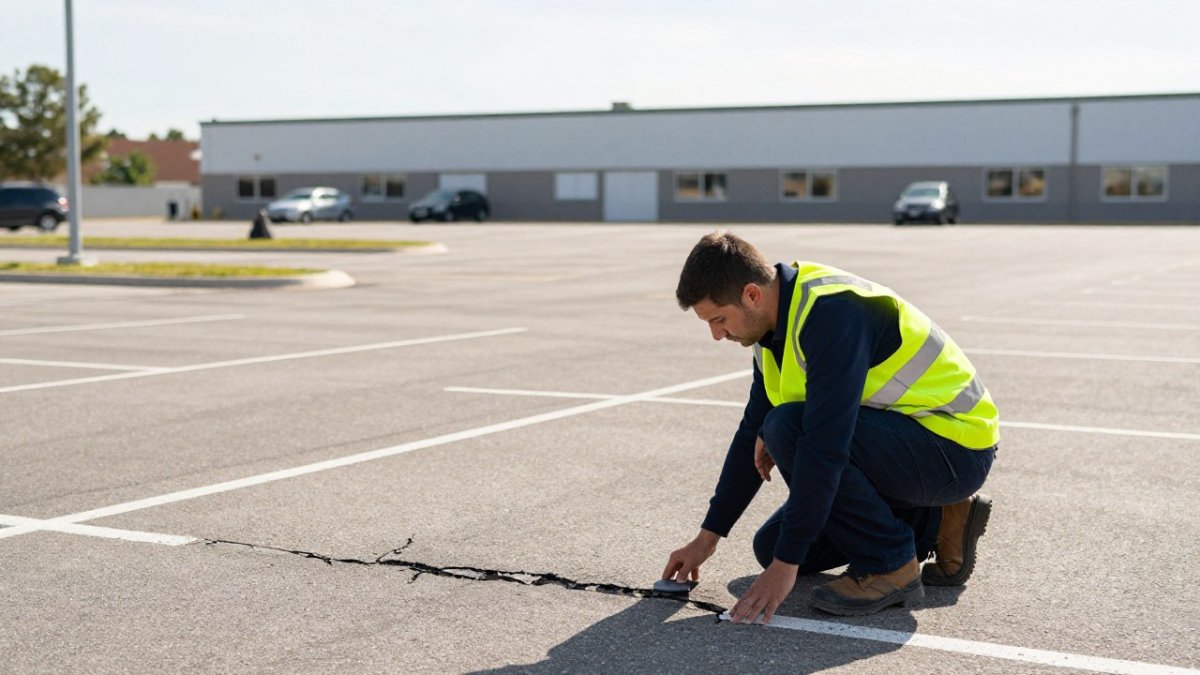
Crew member in a high-visibility vest inspecting cracked asphalt, a key factor affecting sealcoating cost.
  • Lot condition: Heavy alligator cracking, oil stains and standing water all add prep time.
  • Access and phasing: Lots that must stay open to tenants or delivery trucks may need work in sections, which raises labor cost.
  • Operating hours: After-hours or weekend work can carry a premium. Ask whether the bid assumes daytime work.
  • Drying and curing: Sealer needs time to cure before traffic returns. Confirm the bid includes a realistic closure window.
  • Striping and marking: Restriping, accessible parking symbols and fire lane markings are often priced separately from sealing.

Quotes that differ mainly in preparation scope are not equal. A lower bid that skips crack filling may cost more within a year. See which repair and site conditions push a commercial lot quote up or down for more on how these scope differences play out.

Sealcoating Cost Calculator: Build an Itemized Estimate

Most sealcoating quotes are not directly comparable because bidders assume different scopes and specifications behind the same square-foot rate. The worksheet below is built to expose those differences. Ask every bidder to fill in the same worksheet with measured quantities and unit prices, then compare line by line before comparing totals.

Step 1, Measure the area. Record total paved area in square feet, excluding landscaped islands, curbs and non-paved surfaces. Note whether the bidder measured the same area you did.

Step 2, Specify the sealer and coat count. State the sealer product and the number of coats. One coat and two coats are different products at different prices, and a two-coat job is not a one-coat job with a discount.

Step 3, Price the area-driven work. Multiply area by the quoted per-square-foot rate for cleaning, material and application. Keep material and labor separate if the bidder will show them; if not, ask for the combined rate per coat.

Step 4, Add fixed charges. Mobilization, traffic control and any minimum job charge do not scale with area. List them separately.

Step 5, Add preparation and repairs by quantity. Crack filling is priced by linear foot of crack actually routed and filled. Patching is priced by square foot of failed area. Ask for the measured quantities, not a lump sum.

Step 6, Add striping and marking by quantity. Restriping, accessible parking symbols, access aisles, fire lanes and directional arrows are priced per stall, per linear foot or per marking. Keep them visible on the quote.

Step 7, Reconcile the total. Confirm the total equals the sum of every line item. A total that does not reconcile is a warning sign.

Why quoted square-foot rates differ

Two bidders can quote the same lot at different per-square-foot rates and both be correct, because the rate means different things. The main specification differences are:

  • Coat count: One coat versus two changes both material and labor.
  • Application method: Spray application and squeegee application have different production rates and different material consumption.
  • Sealer formulation: Asphalt-emulsion sealers are the common commercial choice, but additive packages and solids content vary by product. Coal tar sealers are restricted in some areas, so confirm local rules before specifying one.
  • Surface preparation: Power blowing, degreasing oil spots and priming are not always included.
  • Included repairs: Crack filling and patching may be in scope or excluded.
  • Curing and traffic control: A realistic closure window and traffic control plan cost money and should appear on the quote.

A worked example of the reconciliation

Suppose a bidder quotes a per-square-foot rate for two coats, a mobilization charge, a crack-filling quantity in linear feet, and a striping quantity in stalls. Add those four line items and compare the sum to the quoted total. Then do the same for the next bidder. If the totals differ, the line items will show whether the difference is area, coat count, preparation, repairs or striping. That is the comparison that matters, and it is the one a single per-square-foot rate cannot support.

A bid that excludes crack filling or preparation can leave you paying for water damage later. Ask the contractor to confirm in writing which cracks and which preparation steps are included.

Use this worksheet for every bidder. A bid that lists every line item makes it easier to see where the numbers differ.

The steps below follow the worksheet, so each bidder’s quote can be checked line by line against the same measured quantities.

Step What to do Key check
1. Measure the area Record paved square feet, excluding islands, curbs and unpaved surfaces Same area used by every bidder
2. Specify sealer and coats State the product and the number of coats One coat and two coats are different prices
3. Price area-driven work Multiply area by the per-square-foot rate for cleaning, material and application Keep material and labor separate if shown
4. Add fixed charges List mobilization, traffic control and any minimum job charge These do not scale with area
5. Add prep and repairs Price crack filling by linear foot and patching by square foot Ask for measured quantities, not a lump sum
6. Add striping and marking Price restriping and fire lane markings per stall, foot or marking Keep these visible on the quote
7. Reconcile the total Confirm the total equals the sum of every line item A total that does not reconcile is a warning sign

Crack Filling, Striping and Other Add-On Costs

Crack filling is the most common add-on to a sealcoating project. Cracks left open let water reach the base, so filling them before sealing usually makes sense. Price crack filling by linear foot or by job, and ask for the crack length the contractor measured.

Striping and accessible parking marking are separate line items. Lots must meet accessibility marking requirements, and restriping often accompanies a seal job. Keep these costs visible on the quote rather than buried in a lump sum.

A bid that excludes crack filling can leave you paying for water damage later. Ask the contractor to confirm in writing which cracks are included.

How Often to Seal Asphalt and Why Timing Affects Cost

Most commercial lots benefit from resealing every few years, depending on traffic, climate and sun exposure. Sealing too late means the surface has already oxidized and cracked, which turns a maintenance job into a repair job with a higher price.

Scheduling also affects cost. Contractors often have more availability and better rates during slower seasons, but the weather must allow sealer to cure. Plan the work before cracks spread and before tenants or events require a closed lot.

Getting an Accurate Quote for Your Commercial Lot

Start by measuring the lot and documenting its condition with photos. Share the measurements, your access constraints and your operating hours with each bidder so every quote reflects the same scope.

Request an itemized proposal that shows area, sealer and coat count, preparation, crack filling, striping and mobilization separately. Compare the scopes first, then the totals. A reliable contractor will explain every line.

For a site-specific estimate, request a quote through the All-Tech Asphalt Paving, LLC. website.

ASTM standards for asphalt sealer materials

American Society of Civil Engineers guidance on pavement maintenance

Federal Highway Administration pavement preservation resources

Screenshot of alltechasphalt.com interface
All-Tech Asphalt Paving – Concrete Services

Frequently Asked Questions

How much does parking lot sealcoating cost per square foot?

Pricing depends on lot size, surface condition, the number of coats, and how much prep the surface needs. Per-square-foot quotes vary by contractor and region, so the most reliable way to compare is to request itemized bids that state the same scope: cleaning, crack filling, number of coats, and striping. Ask each provider to list mobilization and any job minimums separately. For a current figure tied to your lot dimensions and condition, request a site-specific quote from All-Tech Asphalt Paving, LLC. through its website.

How often does an asphalt parking lot need to be sealed?

Most commercial asphalt lots are sealed on a recurring schedule, often every two to three years, though the right interval depends on traffic volume, sun exposure, climate, and the condition of the surface. Lots with heavy vehicle traffic or significant UV exposure may need attention sooner. Sealing too frequently adds cost without benefit, while waiting too long allows cracks and oxidation to develop, which increases repair expenses. A site assessment helps set the right interval for your property.

Does parking lot sealcoating include crack filling and line striping?

Standard sealcoating covers cleaning and applying sealer to the pavement surface. Crack filling, pothole repair, and line striping are usually separate line items because they involve different materials and labor. Some contractors bundle them into a package, while others price each service individually. When comparing bids, confirm whether crack filling and striping are included, and ask for the cost of each so you can see exactly what you are paying for.

How long should a parking lot stay closed after sealcoating?

Sealcoat generally needs several hours to become traffic-ready in mild weather, though full curing can take longer, and cooler or humid conditions extend drying time. Most contractors recommend keeping vehicles off the surface until the sealer has cured enough to resist tracking. Scheduling work during low-traffic periods, such as evenings or weekends, reduces operational disruption. Ask your contractor for an estimated closure window and a plan for weather delays before work begins.

27 Nov 2026

7 Asphalt Driveway Paving Cost Houston Factors That Decide Your Quote

Last Updated: November 26, 2026

Quick Summary

The asphalt driveway paving cost Houston property owners pay is not a single number from a price list but the sum of four variables: driveway size, ground work needed before asphalt arrives, pavement layer thickness, and site access and haul-off demands. Contractors who quote a single per-square-foot number before seeing your site are guessing.

  • Measure length times width in feet and add aprons, turnarounds, and parking pads.
  • Site preparation is the factor most homeowners underestimate before asphalt is laid.
  • Residential driveways typically use two asphalt layers over a compacted aggregate base.
  • A 1,500 sq ft sample driveway has a planning range of $9,000 to $16,500.
  • Sealcoat every 2-3 years, depending on traffic, to extend driveway life.
What is your driveway quote missing?We provide itemized asphalt and concrete paving quotes for Houston properties.

Get My Paving Quote

Table of Contents

What Drives Asphalt Driveway Paving Cost Houston Property Owners Pay

The asphalt driveway paving cost Houston property owners pay is not a single number pulled from a price list. It is the sum of four variables: driveway size, ground work needed before asphalt arrives, pavement layer thickness, and site access and haul-off demands. Change any one and the quote moves.

Paving crew compacting a base to manage asphalt driveway paving cost Houston homeowners pay

Driveway Size and Square Footage

Square footage sets the baseline for material tonnage and crew hours. A single-car and a two-car driveway can differ by hundreds of square feet, and that difference multiplies across every layer: aggregate base, hot-mix asphalt, and labor.

Measure your driveway’s length and width in feet, multiply them, and add any aprons, turnarounds, or parking pads. That number is the first thing any contractor needs.

Site Preparation, Grading, and Base Prep

Site preparation is where budgets quietly grow and the factor most homeowners underestimate. Old driveway removal, excavation, grading to direct water away from the structure, and compaction of the aggregate base all happen before a single ton of asphalt is laid.

Base preparation is essential, because a base that holds water will fail under traffic no matter how good the asphalt on top is. For how grading and base work fit the full build, see our homeowner tips on installing an asphalt driveway.

Pavement Thickness and Hot-Mix Asphalt Specifications

Pavement thickness and mix design decide how long the driveway lasts. Residential driveways typically use two asphalt layers over a compacted aggregate base, and thicker sections cost more in material but resist rutting and cracking far better under repeated loads.

Hot-mix asphalt is specified by mix design, and the right specification depends on traffic: a driveway carrying only passenger vehicles needs less than one handling delivery trucks or heavy equipment. Our residential asphalt mix comparison walks through the options.

Asphalt Driveway Paving Cost Houston Per Square Foot Explained

The asphalt driveway paving cost Houston per square foot is a range that shifts with the four factors above, not a fixed rate. Contractors who quote a single per-square-foot number before seeing your site are guessing.

Pricing depends on quantity, dates, and delivery, as well as site conditions. For current prices or a quote, visit the All-Tech Asphalt Paving, LLC. website.

Here is how per-square-foot pricing is actually assembled:

Cost Component What It Covers Why It Varies
Old driveway removal Demolition, loading, haul-off Depth and access
Excavation and grading Cutting to grade, shaping for drainage Soil conditions, slope
Aggregate base Material, spreading, compaction Base depth required
Hot-mix asphalt Material by tonnage Thickness and mix design
Labor and equipment Crew hours, rollers, pavers Project size and site access

The Tonnage Math Behind the Square-Foot Price

Asphalt is bought and placed by the ton, so the per-square-foot price is really a tonnage calculation in disguise.

When comparing bids, ask what base depth and asphalt thickness each one assumes.

What Moves the Per-Square-Foot Number in This Market

Site conditions are a common reason two driveways of identical size price differently:

  • Clay-heavy soils. Expansive clay holds water and shifts with wetting and drying. Where the subgrade is unstable, the base must be over-excavated and replaced with select fill, adding cost per square foot before any asphalt is placed.
  • Drainage corrections. Flat lots, lots that drain toward the house, and lots with no positive fall to the street often need grading, swales, or a French drain, priced separately and able to rival the paving cost on a difficult site.
  • Access and haul-off. A narrow side yard, a fence, or a low utility line limits equipment size and slows the crew. Long haul distances to the plant add trucking cost per ton.
  • Removal depth. A thin worn surface removes cheaply; a thick failed driveway with a buried concrete base removes slowly and hauls heavy.

When you compare bids, ask each contractor to break their number into these lines and to state base depth, asphalt thickness, and mix design in writing. A bid that cannot be itemized cannot be compared fairly.

Using an Asphalt Driveway Paving Cost Houston Calculator

A driveway paving cost calculator can give a rough planning range, not a final price.

Use one to sanity-check a bid, never to replace one. A calculator cannot see failed base, blocked equipment access, or drainage that needs correcting before paving.

What a 1,500 Sq Ft Asphalt Driveway Cost Looks Like Itemized

A 1,500 sq ft asphalt driveway cost breaks into the same components as any other size, just scaled. Picture a driveway roughly 12 feet wide and 125 feet long, enough for two vehicles side by side with room to walk past.

The sample below is illustrative, not a quote. Seeing how a bid is assembled line by line helps you compare two quotes fairly.

Line Item Quantity Basis Planning-Level Cost
Removal of existing asphalt 1,500 sq ft, load and haul $1,500 – $3,000
Excavation and grading Cut to grade, shape for fall $1,200 – $2,500
Aggregate base, 4-6 in. compacted ~25-35 tons crushed stone $2,000 – $3,500
Hot-mix asphalt, 2-3 in. compacted ~14-21 tons of mix $3,500 – $6,000
Compaction, finishing, cleanup Crew hours, roller, paver $800 – $1,500
Total planning range $9,000 – $16,500

Planning-Level Cost

Removal of existing asphalt $1,500 – $3,000
Excavation and grading $1,200 – $2,500
Aggregate base, 4-6 in. compacted $2,000 – $3,500
Hot-mix asphalt, 2-3 in. compacted $3,500 – $6,000
Compaction, finishing, cleanup $800 – $1,500
Total planning range $9,000 – $16,500

Where the Sample Estimate Moves

Real bids can differ from a sample estimate depending on site conditions:

  • Failed base or soft subgrade. Over-excavation and select fill can add a meaningful line not in the sample.
  • Drainage work. A French drain, swale, or regrading to move water away from the foundation is priced separately and can add several thousand dollars on a difficult lot.
  • Difficult access. Fences, tight side yards, and steep grades slow equipment and add labor hours.
  • Thicker pavement. Moving from 2 to 3 inches of asphalt adds roughly 7 tons of mix on this driveway, plus base and labor.
  • Utility conflicts. Relocating or protecting irrigation, gas, or electrical lines adds coordination cost.

We quote each line separately so you can see where the money goes and question any line that looks off. To see how the same line items scale to other sizes, our asphalt driveway cost calculator guide walks through the inputs.

Asphalt vs. Concrete Driveway Cost Calculator Comparison

Comparing asphalt and concrete on upfront price alone misses the point. Each material has different cost and maintenance tradeoffs over its service life.

Factor Asphalt Concrete
Upfront install cost Lower Higher
Repair approach Patch and overlay Section replacement
Resurfacing Overlay extends life Limited options
Cure time before use Hours to a day Days
Cold-weather behavior Flexible More prone to cracking
Long-term upkeep Sealcoat on a schedule Joint and crack sealing

For a side-by-side cost comparison tool built for this decision, our asphalt vs. concrete cost calculator guide covers the inputs that matter.

Long-Term Ownership Costs and Maintenance Schedule

A practical maintenance schedule:

  • Sealcoat every 2-3 years, depending on traffic
  • Inspect for cracks each spring and fall
  • Fill cracks before they widen past a quarter inch
  • Keep edges supported and clear of vegetation
  • Repair potholes and depressions promptly

Our guide to preventing asphalt driveway cracking covers each of these in detail.

Get a Written Asphalt Paving Quote From All-Tech

A written quote turns a conversation into a document you can compare, question, and hold a contractor to. Ask for a written quote that includes the scope of work, start date, and material specifications.

If you want to know exactly what to request before you call anyone, our guide on getting a professional asphalt driveway quote lays out the questions. When you are ready, contact our team to schedule a site visit.


Houston properties face clay soils, heavy rain, and heat that punish a poorly built driveway. All-Tech Asphalt Paving, LLC. builds driveways to handle all three, using specialized excavation machinery for fast site prep, an owned fleet of concrete mixer trucks to keep projects on schedule, and materials that meet or exceed state and federal standards. Get started with All-Tech Asphalt Paving, LLC. and get a written, itemized quote you can compare line by line.

Frequently Asked Questions

What is the average asphalt driveway paving cost per square foot in Houston?

Per-square-foot pricing depends on the scope of work, including material, labor, equipment, and base prep. Ask each contractor to break the quote into those line items so you can compare bids on the same scope instead of a single blended figure.

Is 2 inches of asphalt enough for a driveway?

A driveway’s performance depends on the aggregate base beneath the asphalt being properly graded and compacted. Heavier traffic calls for more total pavement structure.

How do I use a cost calculator to estimate a 1,500 sq ft asphalt driveway?

Measure the actual paved area in square feet, not the lot size, then multiply by the per-square-foot range your contractor gives you. Add line items for old driveway removal, grading, and drainage if your site needs them. A calculator gives a planning range only. Site soil and drainage conditions can shift the final number, so treat the calculator output as a budget check before requesting written quotes.

How does asphalt driveway cost compare with concrete?

Asphalt and concrete each have different upfront costs and maintenance needs, and asphalt can often be resurfaced rather than fully replaced. The right choice depends on how long you plan to own the property, how heavy the traffic is, and whether the site has drainage or soil conditions that favor one material. Compare total ownership cost over 15 to 20 years, not just the bid price.

26 Nov 2026

How to Fix Alligator Cracks in Asphalt: A Practical Repair Guide

Last Updated: November 25, 2026

Quick Summary

To fix alligator cracks in asphalt, remove the cracked pavement down to solid base, clean the area, then fill and compact patch material in lifts and seal the edges. Alligator cracks are a fatigue failure, so a patch only holds if the base underneath is sound and dry.

  • Alligator cracking is a fatigue failure usually driven by a weak aggregate base or subgrade.
  • Cold patch is a temporary repair that does not restore structural strength.
  • An overlay only works if the base is repaired first, or cracks reflect through.
  • Press a screwdriver into the base; if it sinks easily or feels wet, the base has failed.
  • Patching over a wet base traps moisture and guarantees the repair fails.
Is your cracked asphalt a patch job or a rebuild?All-Tech Asphalt Paving repairs, overlays, and rebuilds asphalt and concrete for lasting results.

Get a Quote

Table of Contents

Causes of Alligator Cracking in Asphalt

Alligator cracks are interconnected, web-like fissures that appear when the pavement underneath can no longer carry the load above it. This guide explains what causes them and how to fix alligator cracks in asphalt without wasting money on a repair that won’t hold.

Alligator cracking is a fatigue failure of the asphalt layer, usually driven by a weak aggregate base or subgrade. The surface flexes under traffic until it cracks in a grid, so filling those cracks without addressing the base is why so many repairs fail within a season. Common drivers include base failure, poor drainage, heavy traffic, aging asphalt, and oil contamination.

Asphalt Institute guidance on pavement distress classifies this as load-associated fatigue cracking, which matters because it tells you the problem starts below the surface.

If you’re seeing widespread cracking, it’s worth understanding why asphalt pavement fails prematurely. And once you know the cause, preventing driveway cracking becomes a maintenance routine rather than a guessing game.

Best Asphalt Alligator Crack Repair: Cold Patch vs. Overlay

The best repair for alligator cracks depends on how far the damage spreads: localized cracking with a sound base can often be patched, while widespread cracking usually needs an overlay or full-depth reconstruction.

Repair Method Best For Lifespan Watch Out For
Cold patch Small, isolated spots Short-term Fails fast if the base is wet
Overlay Widespread fatigue cracking Medium to long Cracks reflect through if base is weak
Reconstruction Failed base, deep damage Long-term Highest cost

Cold patch is a temporary repair, convenient and DIY-friendly, but it does not restore structural strength. An asphalt overlay over alligator cracks only works if the base is repaired first; skip that step and the crack pattern reflects straight through the new layer within a couple of years.

For a deeper look at material choices, see our comparison of the best asphalt mix for residential driveways.

Repair It Right: Prep, Patch, and Know When to Call a Pro

Good prep is what determines how long a patch lasts. These steps cover a small DIY repair; scale up the method, not the shortcuts.

Step 1: Assess the damage. Press a screwdriver into the base under a cracked section. If it sinks easily or feels wet, the base has failed and a patch won’t hold.

Step 2: Saw-cut a square. Clean, straight edges key the patch in and stop it from raveling.

Step 3: Remove the broken asphalt. Excavate down to solid base. Remove all loose material and any oil-contaminated soil.

Step 4: Clean the area. Sweep out debris and dust so the patch bonds to a clean, dry surface.

Step 5: Fill and compact in lifts. Place patch material in layers, tamping each one. Overfill slightly, then compact flush.

Step 6: Seal the edges. A thin bead of crack sealer around the perimeter keeps water out.

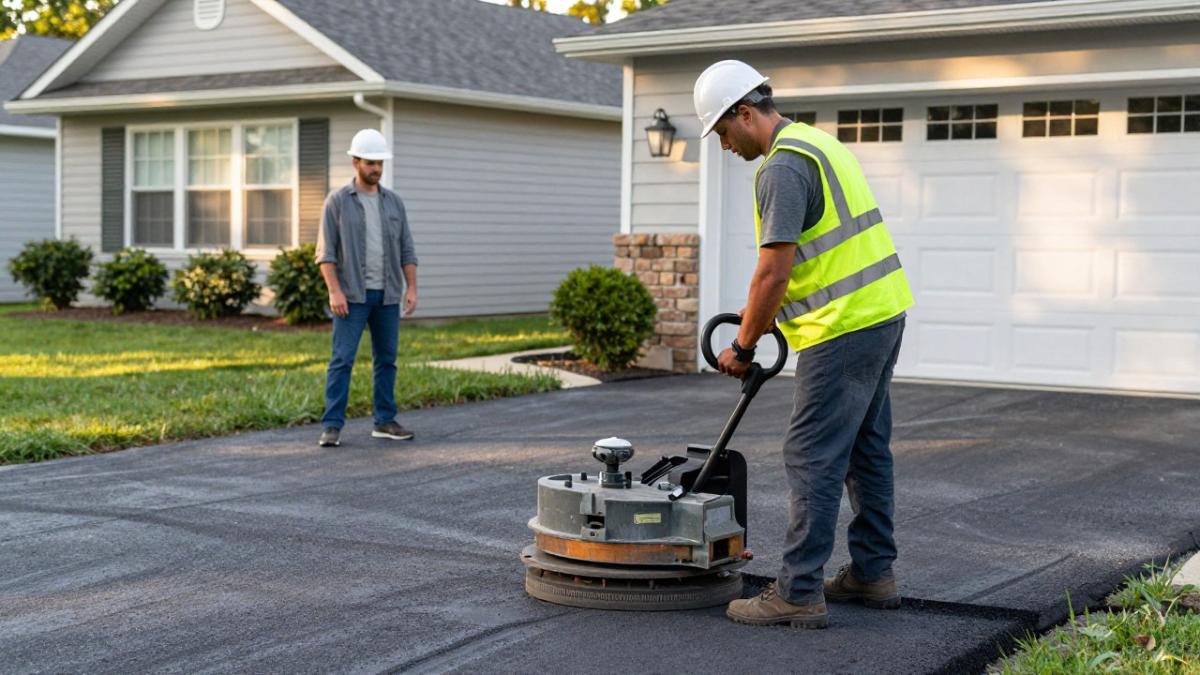
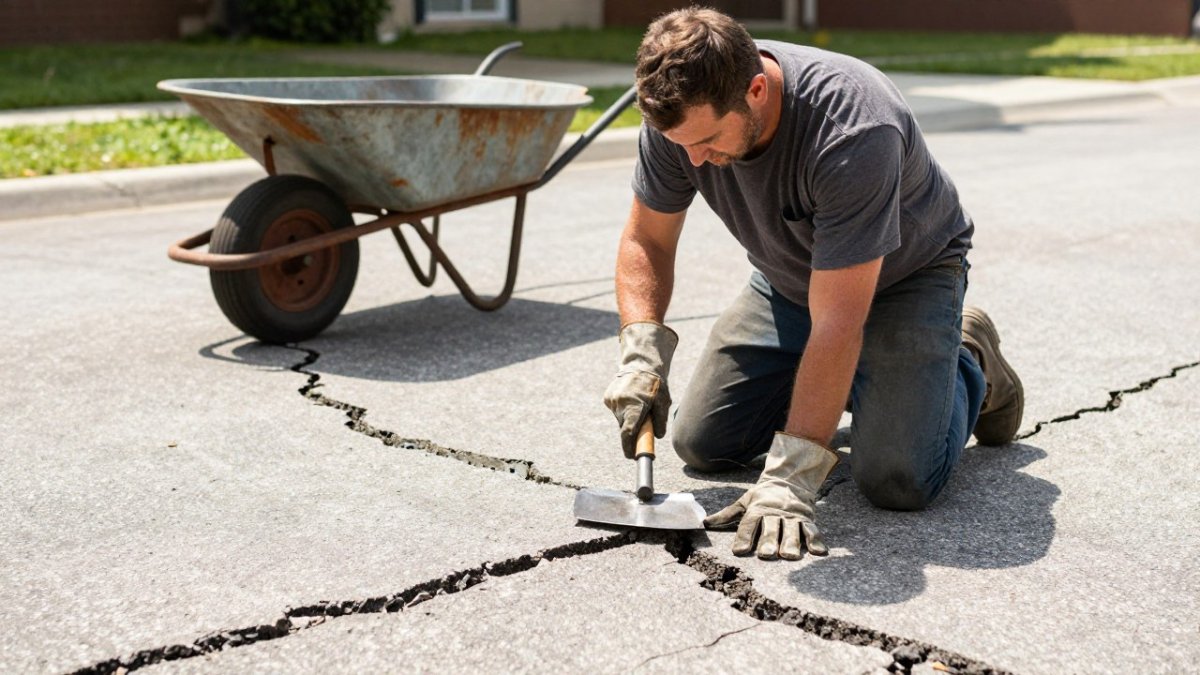
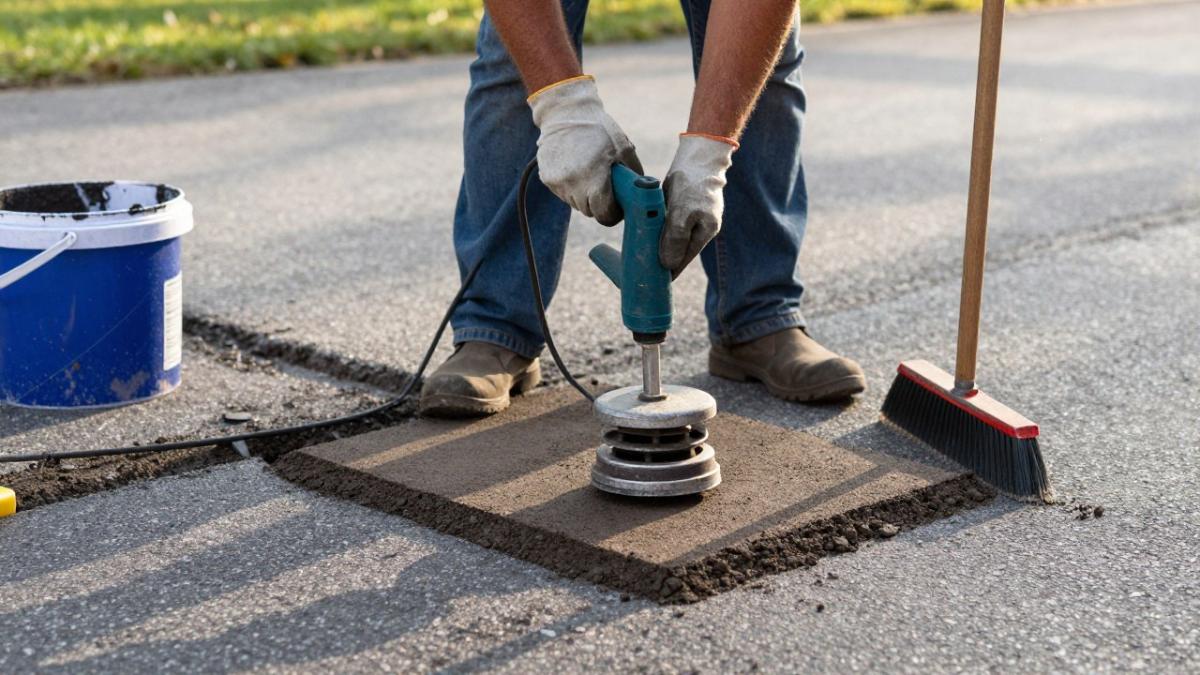
Worker compacting a patch into an asphalt driveway to repair alligator cracks using a hand tamper

Watch out: patching over a wet base traps moisture and guarantees the repair fails.

When to call a pro: if cracking covers a large area, the base is saturated, or the surface is pushing up or sinking. Then read cost factors behind a repair quote and how to compare and hire paving companies before you make calls.

That’s also where we come in. All-Tech Asphalt Paving, LLC. provides asphalt repairs, overlays, and total reconstruction, using specialized excavation machinery and an owned fleet of concrete mixer trucks. Our materials are chosen to meet or exceed state and federal standards, and application follows manufacturer specifications.


Fixing alligator cracks properly means fixing what’s underneath them, not just the surface you can see. If the damage runs deeper than a patch can solve, get a professional assessment before you spend on a repair that won’t last. Get started with All-Tech Asphalt Paving, LLC. and put a repair plan in place that holds up season after season.

Frequently Asked Questions

Can alligator cracking in asphalt be repaired, or does it always mean replacement?

Small, isolated areas of alligator cracks can be repaired by cutting out the failed section, removing the broken asphalt, and patching with hot-mix or cold-patch material. Widespread cracking across a large area usually points to base failure, and patching those spots is a temporary fix at best. If the pattern covers a significant portion of the surface or the base is soft, full-depth repair or replacement is the durable answer.

Can you pave over alligator cracks with an asphalt overlay?

An overlay only works when the base underneath is still sound. Paving over cracks without fixing the base traps the problem and the new layer cracks in the same pattern within a few seasons. For localized damage, cut out the failed asphalt and patch before overlaying. If the base has failed across the lot, the base needs reconstruction first, then a fresh surface.

What causes alligator cracks in asphalt?

Alligator cracks, also called fatigue cracking, usually start with a weak aggregate base, poor drainage, or years of heavy traffic load stress. The surface flexes over a failing base until interconnected cracks form. Oil contamination and thin pavement layers speed up the process. Treating the crack pattern without addressing the base failure underneath rarely lasts.

25 Nov 2026

How to Meet Parking Lot Paving Drainage Requirements

Last Updated: November 24, 2026

Quick Summary

Meeting parking lot paving drainage requirements starts with the right surface slope, a grading plan that moves water off the pavement, and permits that match local rules. Confirm the local stormwater standard before design begins, because copying a neighboring site’s plan may fail here.

  • A grading plan needs spot elevations, flow arrows, inlet rim elevations, and cross sections.
  • Put catch basins at low corners, valley gutter ends, and where water leaves the pavement.
  • Size inlets with the rational method: Q = C × i × A, using local rainfall data.
  • Surface drainage sheet-flows to curb and gutter, valley gutters, or swales.
  • Schedule basin cleaning and drain maintenance every year to prevent avoidable flooding.
Is your lot draining the way it should?All-Tech Asphalt Paving, LLC. designs and builds commercial paving with drainage done right.

Get a Drainage Quote

Table of Contents

Parking Lot Drainage Requirements: Slope, Grading, and Permitting Basics

Water is the quiet enemy of every asphalt lot. Meeting parking lot paving drainage requirements starts with three things: the right surface slope, a grading plan that moves water off the pavement, and permits that match local rules, so every parking lot paving drainage requirements decision is made up front.

Water needs enough surface slope to flow instead of pooling. Flat pavement is prone to puddles, cracks, and costly repairs.

Permitting varies by jurisdiction, so confirm the local stormwater standard before design begins. Copying a neighboring site’s plan is a common mistake, what passed there may fail here.

Building a Parking Lot Grading Plan That Directs Runoff

A parking lot grading plan shows how the finished surface sheds water to defined collection points. It needs spot elevations, flow arrows, inlet rim elevations, and cross sections, arrows alone are not a grading plan.

Best Practices for Parking Lot Design and Construction

Plantmix Asphalt Industry of Kentucky

Start with the existing subgrade. The prep work before paving decides whether grading holds up, so review how to prepare a commercial lot for asphalt paving before the grader moves in. Then build the plan in this order:

  1. Establish the controlling elevations. Building finished floor, door thresholds, curb returns, and the storm sewer invert at the outlet set the limits. The lot must drain to the outlet without backing water up against a door.
  2. Set high points and flow paths. Put high points at building edges and island tips, then draw the flow path from every high point to a defined collection point. Water with no drawn path finds one on its own, usually a low spot mid-stall.
  3. Assign longitudinal and cross slopes. Design stalls and drive aisles with enough slope to shed water, and keep cross slope within limits that keep cars and pedestrians stable. Confirm the exact values with the local authority having jurisdiction.
  4. Check the accessible route. Accessible stalls and the route to the building entrance have tighter cross-slope limits under federal accessibility standards, so grade them separately from the drive aisles and confirm the current requirements with the authority having jurisdiction.
  5. Verify no runoff crosses a sidewalk, flows onto a neighbor’s property, or ponds against a foundation. Runoff leaving the site is a drainage complaint and, in many jurisdictions, a code violation.

Watch out: a plan that looks fine on paper can fail on site if the subgrade settles. Compact and verify before paving, and check finished elevations after the base course is placed, not just after asphalt.

A complete plan sheet carries existing and proposed spot elevations at inlets, high points, and building corners; flow arrows; inlet rim and invert elevations; and at least one cross section through a typical stall and drive aisle. If a reviewer cannot read the flow path off the sheet, the plan is not finished.

Parking Lot Catch Basin Placement and Inlet Sizing

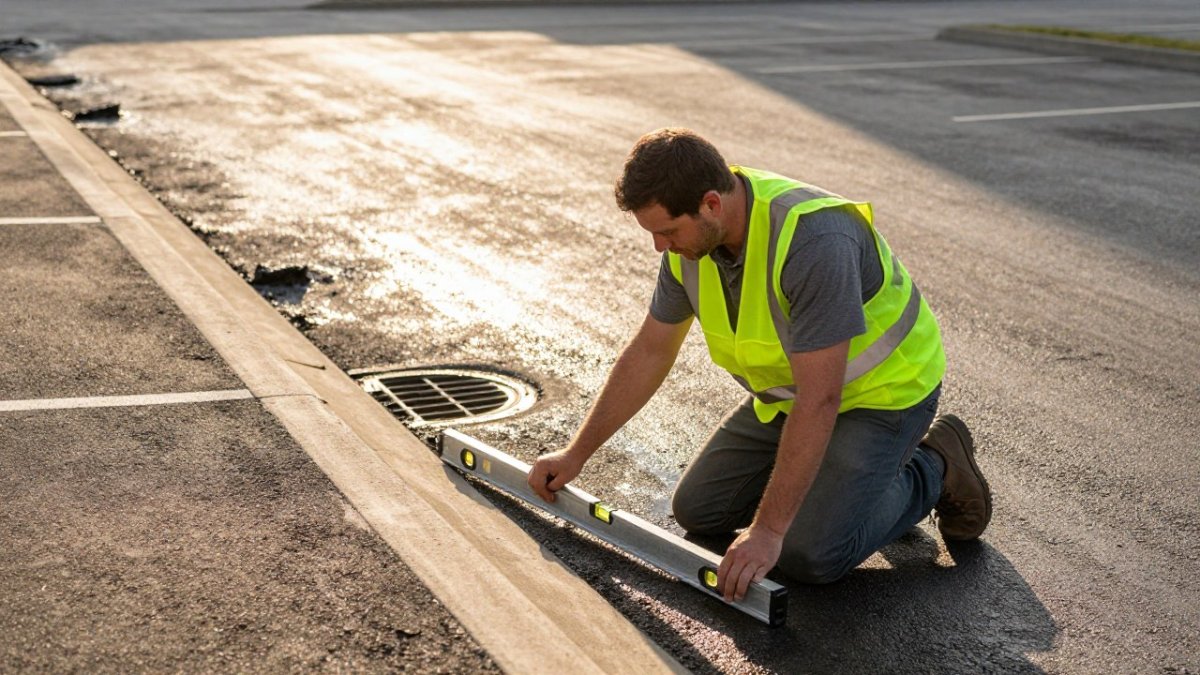
A parking lot catch basin is the concrete box that catches runoff and drops sediment before water enters the storm drain. Placement decides whether the system works.

Put catch basins at the lowest points of the lot, low corners, the end of a valley gutter, and where water leaves the pavement. Space them so no flow path runs more than a few hundred feet before reaching an inlet, and keep flow in a defined channel rather than sheet-flowing across stalls.

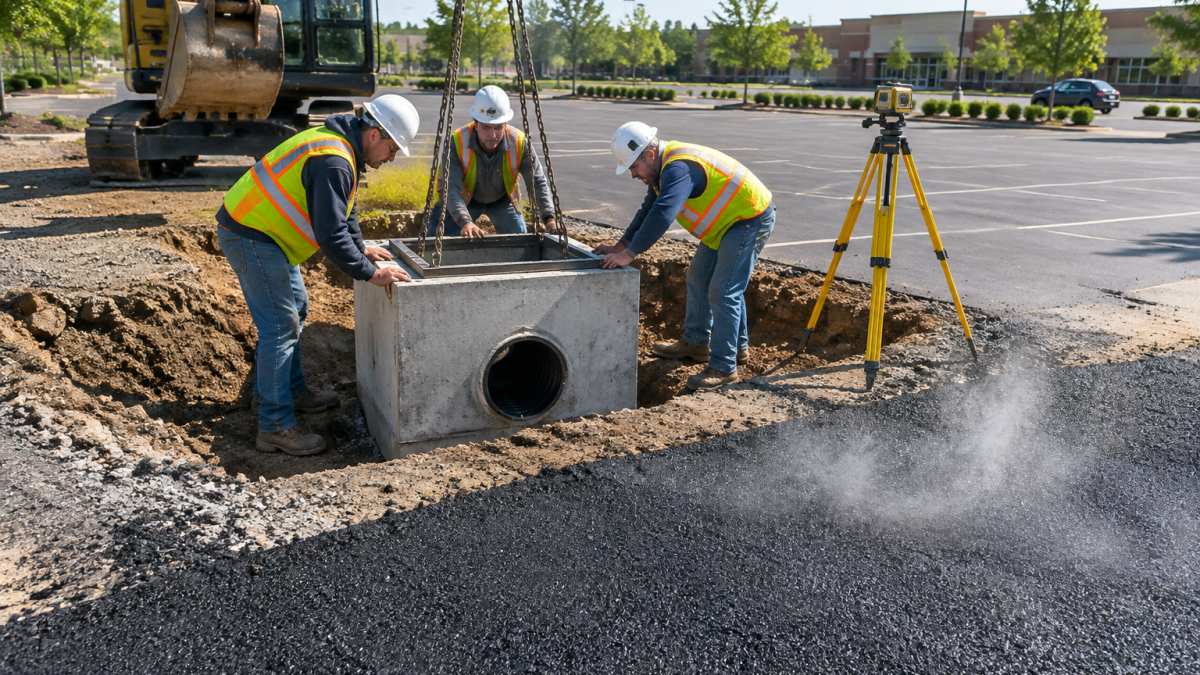
Paving crew installing a catch basin to meet parking lot paving drainage requirements during construction

Sizing is a calculation, not a guess.

The inlet, grate, and pipe leaving the basin must pass the calculated design flow without water backing up above the grate. A basin fitted with an undersized grate will surcharge in the design storm.

Grate capacity matters as much as box size. A grate clogged with leaves passes a fraction of its rated flow, so specify enough open area and, on lots with heavy tree cover, consider a hooded or domed grate that keeps debris from sealing the opening.

Watch out: a basin set at the wrong rim elevation will either pond water around it or stand proud of the pavement and get hit by plows and tires. Verify rim elevation against the grading plan before the concrete sets, and invert elevation before the pipe is connected.

Acceptance checks catch most drainage failures early. Confirm the rim sits at plan elevation, the invert is at or below the pipe elevation, flood-test the inlet to see water enters and leaves, and walk the lot after the first real rain to find low spots the plan missed.

Commercial Parking Lot Drainage Systems: Surface vs. Subsurface

Commercial parking lot drainage systems fall into two families: surface systems and subsurface systems. Each fits different sites.

Surface drainage uses the pavement itself. Water sheet-flows to curb and gutter, valley gutters, or swales, then reaches a collection point. It is simpler to build and easier to inspect.

Subsurface drainage adds buried pipe, trench drains, and inlets that carry water away below grade. It suits large lots, tight slopes, and sites where surface flow would cross traffic lanes. Trench drains work well at loading zones and building entrances.

Poor drainage causes real damage. Standing water seeps into cracks, softens the base, and speeds pavement failure, turning into potholes and alligator cracking. Fixing drainage later costs far more than designing it right.

Watch out: clogged drains and debris are the top cause of avoidable flooding. Schedule basin cleaning and drain maintenance every year.

Once the system is chosen, a consultation helps confirm sizing and layout. You can book a commercial asphalt paving consultation to walk through options for your lot. For a deeper look at how water damage starts, read how to prevent premature asphalt failure. Cost also shifts with drainage scope, and the factors that decide paving cost explain why.

The article groups commercial drainage systems into two families, each suited to different sites.

System How it works Best for
Surface drainage Water sheet-flows to curb and gutter, valley gutters, or swales Simpler to build and easier to inspect
Subsurface drainage Buried pipe, trench drains, and inlets carry water below grade Large lots, tight slopes, flow crossing traffic lanes

Drainage problems rarely announce themselves until the first heavy storm. By then, the base is already wet and the repair bill is climbing. All-Tech Asphalt Paving, LLC. designs and builds paving with drainage baked in, using specialized excavation machinery to shape grades correctly and materials that meet or exceed state and federal standards. Get a quote and protect your pavement before the next rainy season.

Frequently Asked Questions

What slope does a parking lot need for drainage?

Parking lot drainage requirements call for a positive surface slope to move water toward inlets and swales. Accessible stalls and routes have tighter cross-slope limits, so the design has to balance both. Local jurisdictional standards override general guidance, so confirm the minimum slope and cross-slope limits with the authority having jurisdiction before grading begins.

Can I just use gravel for parking lot drainage?

Gravel alone is not a substitute for a designed parking lot drainage system. It can help with infiltration in low-traffic areas, but gravel clogs with sediment and fines over time and does not handle the runoff volume of a paved lot. For commercial lots, use gravel as part of a subsurface or French drain detail behind a catch basin or trench drain, not as the primary drainage solution. Permeable pavement systems are a better fit when infiltration is the goal.

How do you prevent standing water in a parking lot?

Prevent standing water by grading to a positive slope toward collection points, sizing inlets for the calculated runoff, and keeping the system clean. Verify the parking lot grading plan shows flow paths and low points, then inspect after the first rain to confirm no ponding. Schedule annual catch basin cleaning and trench drain flushing, because sediment and debris are the most common causes of clogged drains and puddles on asphalt pavement.

24 Nov 2026

Asphalt Paving Companies Near Me: How to Compare and Hire

Last Updated: November 23, 2026

Quick Summary

To compare asphalt paving companies near me, verify licensing and insurance first, then ask who actually performs the work and read the written scope line by line. A serious proposal states square footage, asphalt depth in inches, base preparation, compaction requirements, and debris removal.

  • Directories rank by proximity and reviews, never revealing insurance, equipment ownership, or a real warranty.
  • Ask for a certificate of insurance naming you as certificate holder and confirm the license number with the issuing authority.
  • Some companies subcontract the paving, changing who answers when something goes wrong.
  • Two bids for the same driveway can differ sharply because they assume different depths and preparation work.
  • Bids that omit base preparation or reduce asphalt depth can differ substantially from others for the same project.
Comparing paving contractors near you?We pave driveways, parking lots, and roads with owned equipment and standards-compliant materials.

Get a Paving Quote

Table of Contents

How to Compare Asphalt Paving Companies Near Me

Searching for asphalt paving companies near me returns names but little proof. This guide shows how to separate qualified paving contractors using criteria that matter more than star ratings.

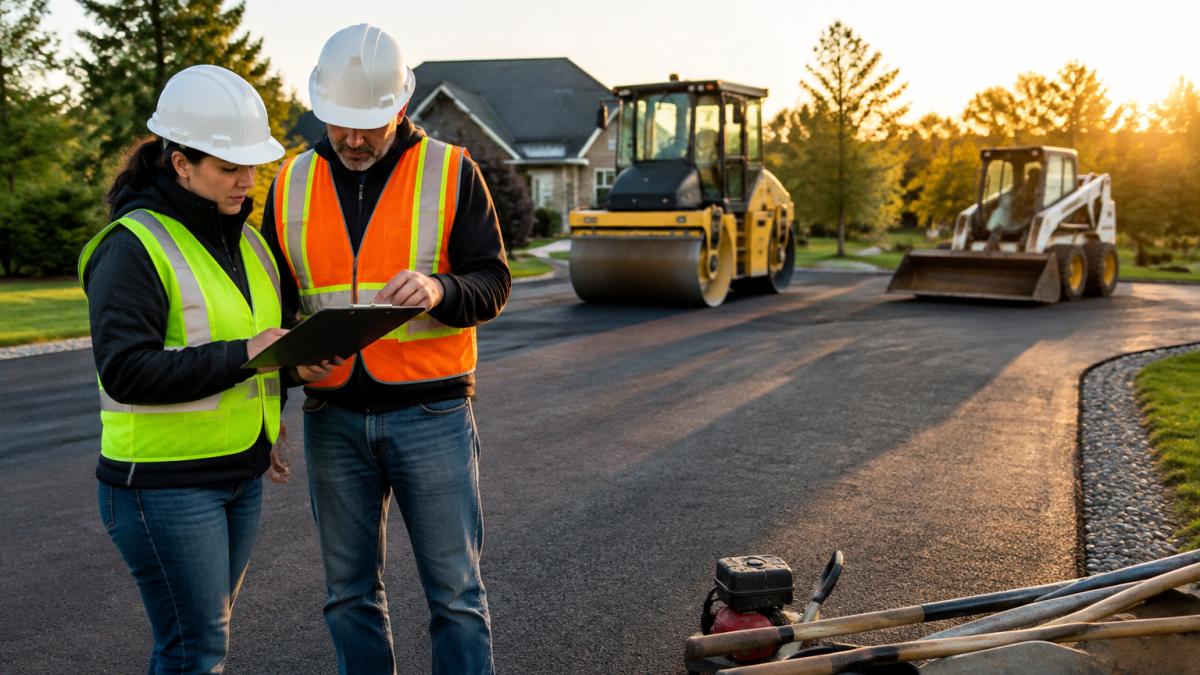
Property manager and contractor reviewing work with asphalt paving companies near a new driveway

Directories rank by proximity and reviews, never revealing insurance, equipment ownership, or a real warranty. Verify licensing and insurance, equipment ownership, written scope, warranty terms, and references.

Criterion What to Check Why It Matters
Licensing and insurance State registration, general liability, workers’ comp Protects you from liability claims
Written scope Square footage, depth, base prep, compaction Prevents change-order surprises
References Recent commercial or residential jobs Proves the track record

Verify licenses and insurance first. Ask for a certificate of insurance naming you as certificate holder and confirm the license number with the issuing authority; hesitation on either is a reason to skip.

Ask who actually performs the work. Some companies subcontract the paving, changing who answers when something goes wrong. Better Business Bureau guidance on hiring contractors recommends asking directly.

Read the written scope line by line. A serious proposal states square footage, asphalt depth in inches, base preparation, compaction requirements, and debris removal.

Ask for references from recent projects.

For a deeper walkthrough, see our guide on how to choose a paving company, this article on getting a professional asphalt driveway quote, and our advice on how to hire a paving contractor.

Asphalt Paving Cost and What Drives Your Estimate

An asphalt paving estimate projects cost from measured square footage, surface condition, base requirements, and material volume. Two bids for the same driveway can differ sharply because they assume different depths and preparation work.

Pricing depends on the specifics of each project, so contact All-Tech Asphalt Paving, LLC. through its website for current pricing or a quote. The variables that move an asphalt paving cost the most:

  • Square footage and shape. Large, simple rectangles cost less per square foot than small, irregular areas.
  • Base condition. Soft subgrade or failed base means excavation and replacement, not just a new surface.
  • Asphalt depth. Driveways and parking lots carry different load requirements, and depth follows the load.
  • Access and drainage. Tight access slows equipment, and drainage corrections add scope.
  • Repair versus new installation. Patching and sealcoating cost far less than full reconstruction.
  • Season and scheduling. Peak paving months book out, and off-season work can be scheduled differently.

Bids that omit base preparation or reduce asphalt depth can differ substantially from others for the same project.

For a detailed breakdown, read what decides how much paving a parking lot costs.

Get a Quote from All-Tech Asphalt Paving

An accurate asphalt paving quote depends on the specifics of each project. At All-Tech Asphalt Paving, LLC., quotes are requested through the company’s website., measure the area, and check base and drainage before putting a number on paper.

We own and operate a private fleet of concrete mixer trucks and utilize specialized excavation machinery. Our materials meet or exceed all state and federal standards and application follows strict manufacturer specifications.

To see how the process works from first call to signed proposal, follow our steps to book a commercial asphalt paving consultation.


Comparing paving contractors comes down to proof: insurance certificates, a written scope, owned equipment, and references you can call. All-Tech Asphalt Paving, LLC. built its operation around those basics, with an owned mixer fleet, specialized excavation equipment, and materials that meet state and federal standards. Get started with All-Tech Asphalt Paving, LLC. and put your project on a schedule you can plan around.

Frequently Asked Questions

How do I choose a reliable asphalt paving company?

Start by asking for proof of licensing and insurance, then request a written estimate that lists the scope, materials, and warranty terms. Read asphalt paving contractor reviews for patterns in timeliness and follow-through, not just star ratings. Ask how long the company has served your area, whether it owns its equipment or subcontracts, and what happens if weather delays the schedule. A contractor who answers these clearly before you sign is usually the safer hire.

What should an asphalt paving estimate include?

A complete asphalt paving estimate should spell out square footage, pavement thickness, base preparation, milling or removal of old surface, debris removal, compaction, and sealcoating if included. Ask whether the price covers permits, traffic control, and cleanup. The estimate should state the warranty length and what it covers. Because asphalt paving cost depends on site conditions, access, and project size, get the scope in writing so you can compare bids line by line instead of by total price alone.

How long does asphalt driveway installation take?

Most residential asphalt driveway installation takes one to three days on site, depending on size, base work, and weather. New asphalt needs time to cure before regular vehicle traffic, often about three to seven days for light use and longer for heavy vehicles. Commercial parking lot paving runs longer because of phasing and traffic control. Ask the contractor for a written schedule and a rain plan so delays do not leave you without communication.

23 Nov 2026

How Do You Prepare a Commercial Lot for Asphalt Paving?

Last Updated: November 22, 2026

Quick Summary

Commercial lot preparation follows a set sequence: assess the site and define scope, confirm utility locates and permits, then strip unsuitable material, excavate to design depth, grade for drainage, stabilize the soil, and compact the aggregate base in lifts until it passes density checks. Confirm drainage and dry weather readiness before the surface course goes down.

  • Log cracking, potholes, and drainage problems during the initial site assessment.
  • Removal depth depends on soil testing, not guesswork.
  • Slope the subgrade so water moves toward drainage structures instead of ponding.
  • Skipping density testing and proof rolling is the most expensive shortcut in paving.
  • Confirm catch basins are clear and slopes correct before the surface course.
Is your lot ready for asphalt paving?All-Tech Asphalt Paving, LLC. handles excavation, subgrade prep, and paving in-house.

Get a Paving Quote

Table of Contents

Before the Crew Arrives: Your Commercial Asphalt Paving Project Checklist

Weeks of commercial lot preparation before mobilization largely decide whether pavement lasts or fails early. Commercial lot preparation comes down to sequencing: assess, plan, clear, and document.

Start with a site assessment to log cracking, potholes, and drainage problems, then define scope, full reconstruction, mill and overlay, or spot repair, and confirm utility locates and permits before anyone digs. Verify equipment ownership, ask for recent references, and require written documentation that materials meet standards; choosing the lowest bid without confirming the contractor has the excavation and hauling equipment needed for the job is a common mistake.

Build a realistic schedule before mobilization so weather delays don’t blindside you. Read our guides on how to plan an asphalt paving project timeline and avoiding paving contractor project delays before you sign.

Parking Lot Subgrade Preparation: Excavation, Grading, and Compaction

Subgrade preparation is the foundation step: remove unsuitable material, excavate to design depth, grade for drainage, stabilize the soil, and compact the aggregate base in lifts until it passes density checks. Crews strip existing pavement, debris, and any soft or organic soil that can’t support load; removal depth depends on soil testing, not guesswork.

The subgrade needs a slope that moves water toward drainage structures, not ponding in the middle of the lot. The aggregate base goes down in lifts, each compacted and tested before the next, skipping density testing and proof rolling is the most expensive shortcut in paving.

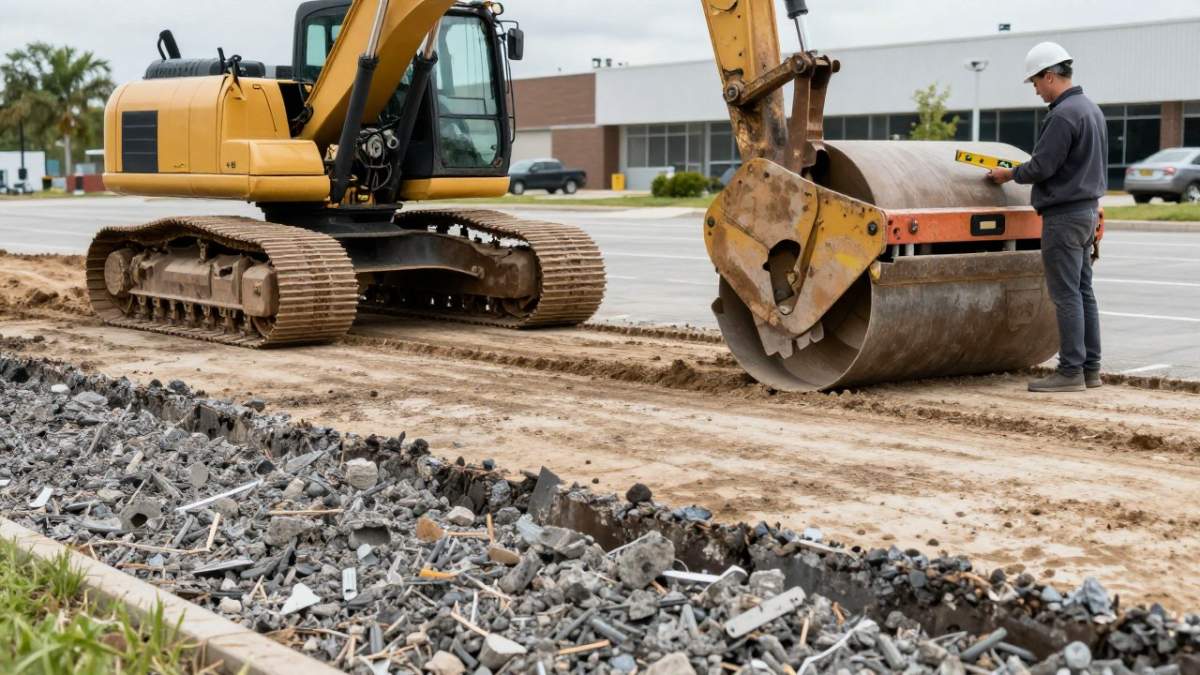
Excavator and roller working on commercial lot preparation as a crew member checks the subgrade level

Poor subgrade work causes reflective cracking and settlement within a few seasons; our article on why professional excavation matters for paving explains the failure modes. Once the base passes, verify it against commercial asphalt quality standards before the binder course goes down.

Subgrade work follows a set sequence before the binder course goes down.

Step What to do Note
Strip and remove Remove existing pavement, debris, soft or organic soil Removal depth depends on soil testing
Excavate Excavate to design depth Foundation step of preparation
Grade Slope subgrade toward drainage structures Water should not pond mid-lot
Stabilize Stabilize the soil Part of subgrade preparation
Place aggregate base Put base down in lifts Each lift compacted and tested
Test density Compact until it passes density checks Skipping density testing is the most expensive shortcut
Verify base Check base against commercial asphalt quality standards Done before binder course

Commercial Parking Lot Drainage and Weather Readiness

Commercial parking lot drainage must be confirmed before the surface course: catch basins clear, slopes correct, and runoff directed away from the pavement structure. Standing water softens the base and accelerates cracking, so confirm inlets and piping are functional and that grading sends water to them.

Asphalt placement needs dry conditions and suitable temperatures. Build weather contingency into the schedule and agree in writing how delays get communicated.

When prep, drainage, and readiness checks are done, the project moves fast. If you’re ready to talk through your lot, book a commercial asphalt paving consultation and we’ll walk the site with you.


Preparing a commercial lot is a sequence, not a single task, and skipping steps shows up as cracking and settlement years later. All-Tech Asphalt Paving, LLC. handles the full scope in-house, from specialized excavation machinery for fast production rates to materials that meet or exceed state and federal standards, so your project stays on schedule. Get started with All-Tech Asphalt Paving, LLC. and prepare your lot the right way from the first day.

Frequently Asked Questions

What site work is needed before paving a commercial parking lot?

Commercial lot preparation typically involves a site assessment, utility locating, permit checks, removing existing pavement and debris, excavation to the required depth, soil testing, grading for slope, stabilizing weak subgrade, and installing a compacted aggregate base. Drainage structures and traffic control plans should also be settled before paving starts. Skipping any of these steps shows up later as cracking, potholes, or standing water, so confirm each one with your contractor in writing.

How can you tell if a parking lot base is ready for asphalt?

A ready base passes proof rolling without rutting or pumping, holds the specified grade and slope for commercial parking lot drainage, and meets compaction density confirmed by field testing. The surface should be uniform, free of soft spots, debris, and standing water. Ask your contractor for the density test results and a final inspection record before the binder course goes down. If the base deflects under a loaded truck, it is not ready.

How long does commercial lot preparation take before paving?

The commercial asphalt paving timeline for preparation usually runs several days to a few weeks, depending on lot size, how much existing pavement must be removed, soil conditions, and weather. Utility locating and permits can add lead time before equipment ever arrives. A phased plan keeps part of your lot open during work. Ask for a written schedule with milestones, plus a rain delay policy, so you know exactly when your lot will be usable again.

22 Nov 2026

7 Things That Decide How Much Paving a Parking Lot Costs

Last Updated: November 21, 2026

Quick Summary

Parking lot paving cost is not a single rate; it is the sum of site conditions, material volumes, and the work required to make a lot drain and hold up. Two jobs with identical square footage can land far apart on price, because a flat, well-drained lot with solid subgrade needs far less work than a site with soft soil, poor drainage, and failing base.

  • Subgrade is the native soil beneath the pavement and decides how much base material the lot needs.
  • A complete per-square-foot figure should include excavation, aggregate base, asphalt, labor, equipment, and mobilization.
  • Asphalt generally carries the lower initial installation cost, while concrete typically carries a longer service life.
  • Resurfacing costs less than new construction because the base and drainage already exist.
  • A bid that omits mobilization, striping, or permit fees is incomplete, not cheaper.
What’s driving your paving quote?All-Tech Asphalt Paving, LLC. provides itemized commercial paving estimates backed by in-house equipment and quality materials.

Get a Paving Quote

Table of Contents

What Drives Parking Lot Paving Cost: The Variables That Move the Number

Ask ten contractors how much does it cost to pave a parking lot and you’ll get ten different numbers, because parking lot paving cost is not a single rate. It is the sum of site conditions, material volumes, and the work required to make a lot drain and hold up. Pricing is typically built from the ground up, and the ground is usually where the surprises hide.

Two jobs with identical square footage can land far apart on price. A flat, well-drained lot with solid subgrade needs far less work than a site with soft soil, poor drainage, and failing base. That difference shows up in excavation hours, aggregate tonnage, and haul-off costs long before a single ton of asphalt is laid.

Below, we break down the seven variables that actually move the number, so you can read a bid with confidence and spot the line items that deserve scrutiny.

Site Conditions and Subgrade Preparation

Subgrade is the native soil beneath the pavement structure, and it decides how much base material the lot needs. Soft, wet, or clay-heavy soil requires excavation and replacement with compacted aggregate, and that work is labor, equipment, and trucking.

Materials, Depth, and Drainage Requirements

Pavement depth and mix design drive material cost directly. Commercial lots typically need a thicker asphalt section than a residential driveway because they carry heavier loads and more traffic. Aggregate base thickness, binder course, and surface course each add tonnage.

Drainage is the other half of this equation. Grading to move water off the lot, installing catch basins, and tying into storm systems all carry cost, and skipping them shortens pavement life.

Asphalt Parking Lot Cost per Square Foot: What the Number Includes

Asphalt parking lot cost per square foot is a bundled figure covering site preparation, aggregate base, asphalt materials, labor, equipment, and mobilization. It is not just the blacktop. When a quote looks unusually low, something in that bundle is usually missing.

Paving crew using a mechanical spreader and roller to manage parking lot paving cost on a commercial site

A complete per-square-foot figure should account for:

  • Excavation and grading of the existing surface
  • Hauling and compacting aggregate base
  • Asphalt binder and surface courses at specified depths
  • Curb work, striping, and pavement markings
  • Mobilization of equipment and crew to the site

Two bids at the same per-square-foot rate can include very different scopes. Ask each contractor to itemize.

Asphalt vs. Concrete Parking Lot Cost: A Material Comparison

Asphalt vs. concrete parking lot cost is the comparison most property managers ask about first, and the honest answer is that the upfront number and the lifetime number point in different directions. Asphalt generally carries the lower initial installation cost, while concrete typically carries a longer service life. The right choice depends on traffic loads, budget timing, and how long you plan to own the asset.

Factor Asphalt Concrete
Upfront installation cost Lower Higher
Typical service life Shorter, with maintenance Longer
Routine maintenance Sealcoating, crack repair Joint sealing, occasional panel repair
Cure time before use Fast Longer
Best for Tight budgets, fast turnaround Heavy loads, long ownership

What the Per-Square-Foot Numbers Actually Reflect

A per-square-foot price is only meaningful when you know the pavement section behind it. Asphalt parking lots are built in layers: an aggregate base, a binder course, and a surface course, each placed at a specified compacted thickness.

That is why two asphalt quotes at the same per-square-foot rate can differ by thousands of dollars: one may include a six-inch base and a two-inch surface, the other a four-inch base and an inch and a half of surface. Ask for the section in writing, base thickness, binder thickness, surface thickness, and mix designation, before you compare totals.

The Lifecycle Math Most Bids Leave Out

The upfront comparison is only half the decision. Over a full service life, asphalt typically requires sealcoating every few years, crack sealing as the surface ages, and a mill-and-overlay resurfacing at some point before full replacement.

Watch out: a lifecycle comparison built on a contractor’s optimistic service-life assumption is not a comparison at all. Ask each bidder to state the assumed service life and the maintenance schedule behind it.

When Asphalt Wins on Price

Asphalt is often considered when the budget is fixed and the lot needs to open quickly. It generally cures faster than concrete and can be resurfaced later, which allows spending to be phased over time.

When Concrete Justifies the Higher Upfront Cost

Concrete is often chosen for heavy-duty industrial sites, loading zones, and properties held long term, where a longer service life may offset the higher installation cost over the life of the pavement.

A Note on Hybrid Approaches

Not every lot has to be all one material. Some lots combine materials, using asphalt for drive aisles and general parking and concrete in heavy-load areas such as loading zones and dumpster pads. Ask your contractor whether a hybrid section makes sense for your traffic pattern before you commit to a single material.

Parking Lot Resurfacing Cost per Square Foot vs. New Construction

Parking lot resurfacing cost per square foot is typically lower than new construction because the base and drainage already exist. Resurfacing, also called repaving or an overlay, mills or cleans the old surface and lays new asphalt over a sound base. New construction costs more because it includes full excavation, new aggregate base, grading, and drainage. The gap between the two is real, but it is not automatic, it depends entirely on what is underneath the surface you are paving over.

What Each Scope Actually Includes

The clearest way to compare the two is line by line. A resurfacing scope generally includes milling or cleaning the existing surface, tack coat, and a new asphalt overlay, plus restriping and any localized patching where the old surface has failed.

That difference in scope is where the price gap comes from. The overlay skips excavation, base, and most drainage work; the new build pays for all of it.

When an Overlay Is the Right Call

An overlay works when the existing asphalt is sound but worn, surface raveling, minor cracking, and oxidation are typical candidates. The base must be intact and well drained, and the existing pavement must be able to carry the new layer without deflecting.

The catch: resurfacing only works if the base is intact. If the subgrade has failed, an overlay just transfers the problem upward. A contractor who recommends resurfacing without checking base condition is selling you a short-term fix.

When Reconstruction Is the Better Investment

Reconstruction is the better call when the base has failed, when drainage is inadequate, or when the lot needs a different pavement section to handle heavier traffic than it was originally built for.

A practical test is to ask what percentage of the existing surface shows structural distress. If the failures are isolated, patching plus an overlay can be cost-effective. If they are widespread, the overlay is a temporary patch on a permanent problem.

How to Compare a Resurfacing Bid to a New-Build Bid

Because the scopes differ so much, comparing the two bids on total price alone is misleading. Ask each bidder to break out excavation, base, paving, drainage, striping, and mobilization as separate line items, then compare the line items that overlap. The resurfacing bid should show patching quantities and the areas being milled; the new-build bid should show base thickness and drainage quantities.

Watch out: a resurfacing bid that does not state how much patching is included is an open-ended change order. Get the patch allowance in writing, with a unit price for anything beyond it.

If you’re weighing the two, our guide on what to expect during parking lot reconstruction walks through the phases and disruption, and the repair-specific variables behind a quote are covered in our breakdown of commercial parking lot repair cost factors.

Permits, Accessibility, and Stormwater Requirements That Add to the Bill

Permits, accessibility standards, and stormwater rules add line items that many estimates overlook. Local permitting fees, accessibility requirements for parking stalls and access aisles, and stormwater management for runoff all carry real cost.

Stormwater management is the one that surprises property managers most. Regulations on how runoff leaves a site can require detention, infiltration, or treatment features, and those are engineered and permitted work.

Build permit and compliance costs into the project estimate early. They are not optional, and they are not small.

How to Measure Your Lot and Use a Parking Lot Paving Cost Calculator

A parking lot paving cost calculator is only as good as the measurements you feed it. Start by measuring the actual paved area, not the property line. Break the lot into simple rectangles, multiply length by width for each, and add them together for total square footage.

Next, count the parking spaces. Cost per parking space is a useful cross-check because stalls, aisles, and striping carry fairly consistent per-stall costs within a region. A quick estimate framework:

  • Measure total paved square footage
  • Count marked stalls and note access aisles
  • Note current surface condition and visible cracking or settling
  • List drainage features already present

Use those numbers to sanity-check any quote you receive. If a bid’s square footage doesn’t match your measurement, ask why before signing. For the repair-specific variables behind a quote, see our breakdown of commercial parking lot repair cost factors.

How to Evaluate Bids and Choose a Paving Contractor

Comparing bids is where most projects are won or lost. The lowest number is rarely the best value, and the highest is not automatically the safest. Compare scope, not just totals.

Ask every contractor the same questions:

  • What pavement depth and base thickness are included?
  • Is mobilization, haul-off, and striping in the price?
  • Who handles permits, and are fees included?
  • What is the schedule, and how are weather delays communicated?
  • Can you provide references from similar-sized projects?

A contractor who answers these in writing is worth more than one who quotes fast and vague. Our guide to choosing a paving company covers the vetting process in detail, and small-business owners can use our contractor hiring guide for small businesses for a tailored checklist.

Watch out: a bid that omits mobilization, striping, or permit fees is not cheaper, it is incomplete. The change order arrives later.

Request a Quote for Your Parking Lot Paving Project

The only reliable way to price your lot is a site-specific estimate. Square-foot ranges help you budget, but they cannot see your subgrade, your drainage, or your access constraints.

At All-Tech Asphalt Paving, LLC., we use specialized excavation machinery and an owned fleet of concrete mixer trucks.

Get started with All-Tech Asphalt Paving, LLC. and turn a rough range into a real number. If you want to see how the process works first, read the steps to book a commercial paving consultation.


Paving a parking lot comes down to seven variables, and the only one you control is who you hire. Get a site-specific estimate from a contractor who itemizes the scope and stands behind the materials. All-Tech Asphalt Paving, LLC. offers itemized commercial estimates, in-house excavation and concrete equipment, and materials that meet state and federal standards. Get started with All-Tech Asphalt Paving, LLC. and price your project with confidence.

Frequently Asked Questions

What factors affect the cost of paving a parking lot?

The biggest drivers are lot size and number of parking spaces, pavement material (asphalt or concrete), and how much site preparation is needed. Subgrade condition, excavation, grading, compaction, aggregate base depth, drainage and stormwater management, curbs, striping, and pavement markings all add to the project estimate. Labor, materials, equipment, mobilization, and regional pricing also move the number. A lot that needs full reconstruction costs far more than one that only needs an overlay, so get an itemized bid rather than a single lump sum.

Is it cheaper to pave a parking lot with asphalt or concrete?

Asphalt usually costs less upfront per square foot than concrete, which is why it is common for large commercial lots. Concrete costs more to install but typically lasts longer and needs less routine maintenance, so the lifecycle cost comparison can favor either material depending on traffic, climate, and how long you plan to own the property. Ask each bidder to show pavement depth, aggregate base thickness, and maintenance assumptions so you compare like for like.

How much does parking lot resurfacing cost per square foot compared with new construction?

Resurfacing, also called repaving or an overlay, generally costs less per square foot than new construction because it reuses the existing base and skips most excavation and grading. The price depends on how much crack repair and patching the old surface needs, the overlay thickness, and whether drainage or curbs must be adjusted. If the subgrade or base is failing, an overlay will not fix it and full reconstruction becomes the better long-term choice.

How can I estimate the cost of a parking lot paving project?

Start by measuring the square footage of the paved area and counting the parking stalls, since per-stall cost is a common budgeting shortcut. Note the current surface condition, drainage issues, and whether you need new curbs or striping. A parking lot paving cost calculator gives a rough range, but only a site visit confirms subgrade condition and pavement depth. Use the estimate to set a budget, then compare at least two or three itemized bids from licensed contractors.

21 Nov 2026

Best Asphalt Mix for Residential Driveways Compared

Quick Summary

Hot mix asphalt (HMA) is the best choice for most residential driveways. It is a dense-graded asphalt mix of aggregate and binder, laid hot, offering a smooth surface and good load-bearing capacity, and most local contractors install it routinely.

  • Hot mix asphalt is a dense-graded mix of aggregate and asphalt binder, laid hot.
  • It is the standard for most residential driveways and routinely installed by local contractors.
  • Its strengths are a smooth surface and good load-bearing capacity.
  • Porous asphalt lets water drain into the base, helping with runoff and ponding.
  • Sub-base preparation and compaction matter as much as the surface mix itself.

Table of Contents

Hot Mix Asphalt Driveway: The Standard Choice for Most Homes

Hot mix asphalt (HMA) is a dense-graded asphalt mix of aggregate and asphalt binder, heated and laid while still hot. It is the standard for most residential driveways across the country, and most local contractors install it routinely.

Construction crew spreading fresh hot mix asphalt on a residential driveway with a paver and roller at sunset.

Its strengths are straightforward: a smooth surface and good load-bearing capacity. Once installed, learn how to keep the surface from cracking over the years. Pricing depends on quantity, site access, and the project schedule, so request a quote through our website for current figures.

Porous Asphalt Driveway and Other Mix Options Compared

Porous asphalt lets water drain through the surface into the base, which helps with runoff and can ease ponding problems.

The article describes how porous asphalt handles water compared with a standard surface. For a step-by-step look at how a driveway is actually installed before you choose a mix, see the homeowner guide.

Mix option Key behaviour Water handling
Hot mix asphalt (HMA) Dense-graded, laid hot Standard surface
Porous asphalt Lets water drain into the base Helps with runoff and ponding

Asphalt Driveway Thickness and Cost to Plan Around

Sub-base preparation and compaction matter as much as the surface mix itself. Before budgeting for a full replacement, check the signs that existing pavement only needs repair.

Cost depends on thickness, square footage, base condition, and local labor. Ask any contractor, including us, for an itemized quote so you can compare the scope of work, not just the total. To see how a professional quote is put together and what it should include, read the quoting guide.

Last Updated: November 20, 2026


Planning a new driveway or repair? Get a quote from All-Tech Asphalt Paving, LLC. and we will walk through the right mix and thickness for your home. GET A QUOTE

Frequently Asked Questions

What is the best asphalt for a residential driveway?

For most homeowners, hot mix asphalt is the best choice for a residential driveway. It is the industry standard and compacts into a dense surface that handles regular vehicle loads. Porous asphalt can work well where drainage is a concern, but it costs more to install and needs more careful maintenance. Pricing depends on quantity, site access, and the project schedule, so request a quote through our website for current figures.

What is the recommended thickness of asphalt for a residential driveway?

Sub-base preparation and compaction matter as much as the surface depth, since a thick layer over weak soil can still crack.

Is porous asphalt a good choice for a residential driveway?

Porous asphalt can be a good option when drainage is a priority, because water passes through the surface instead of running off.

20 Nov 2026

Asphalt Pothole Repair Cost per Square Foot: A Pricing Guide

Last Updated: November 19, 2026

Quick Summary

Pothole repair cost depends on depth, square footage, and mobilization, so shallow spalls under 2 inches are priced on square footage alone while deeper failures add base material and compaction time. On a single small pothole, mobilization can be the largest line item, so bundling several holes into one visit spreads that fixed fee.

  • Shallow spalls under 2 inches deep are priced on square footage alone.
  • Moderate failures 2 to 6 inches add base material to the square footage price.
  • Deep failures past 6 inches require base replacement and compaction time.
  • Cold patch often needs re-touching within one to two seasons, sometimes sooner.
  • A written quote should itemize square footage, depth, material, and mobilization separately.
What should a pothole repair quote include?All-Tech Asphalt Paving, LLC. provides asphalt repair, overlays, and full reconstruction with itemized quotes.

Get a Pothole Quote

Table of Contents

What Drives Asphalt Pothole Repair Cost per Square Foot

Pothole repair cost depends on three variables: how deep the failure goes, how much surface area needs cutting out, and how far a crew has to travel. Pothole repair pricing depends on those three inputs, and guessing at them is how homeowners end up with a patch that fails by the next rainy season.

Square footage sets the baseline. Depth multiplies it. Mobilization adds a fixed charge on top. Miss any one and the estimate will not match the invoice.

Measuring tape across an asphalt pothole, illustrating factors impacting pothole repair cost.

Patch Depth and Square Footage

Surface-area pricing only holds for shallow failures. A pothole that has eaten into the base layer needs full-depth removal, and that changes the math entirely.

  • Shallow spall, under 2 inches deep: priced on square footage alone
  • Moderate failure, 2 to 6 inches: square footage plus base material
  • Deep failure, past 6 inches: square footage, base replacement, and compaction time

A common mistake is measuring only the visible hole. Water spreads sideways under the surface, so the actual repair area is usually wider than what you can see. Cutting back to sound pavement is what separates a patch that holds from one that pops out in a year.

Labor, Materials, and Mobilization Fees

Labor and materials make up the variable portion of any quote. Mobilization is the fixed part: the cost of getting a crew, a truck, and compaction equipment to your property. On a single small pothole, mobilization can be the largest line item on the invoice.

That is why bundling matters. Five potholes across one parking lot repaired in a single visit spread the mobilization fee across all five. Ask any contractor to quote the whole lot, not just the worst hole.

Cold Patch Asphalt vs. Hot Mix: Which Costs Less

Cold patch asphalt costs less up front. Hot mix performs better over time. The useful comparison is not what each costs today, it is what each costs across five years of freeze-thaw cycles, traffic, and water intrusion.

Cold patch comes in a bag, needs no heating, and can be applied in wet or cold conditions. It is the right call for a temporary fix, a winter emergency, or a pothole you need closed today.

Hot mix asphalt is plant-produced, applied at temperature, and compacted with real equipment. It costs more per ton and requires a crew, but it forms a proper bond with the surrounding pavement.

The Five-Year Cost Comparison

A single cold patch bag runs a modest amount at a home improvement store, which is why DIYers reach for it first.

A professional hot patch carries a higher one-time price because it includes mobilization, cutting back to sound pavement, tack coat, hot mix, and compaction. The break-even point depends on traffic, climate, and base condition.

A DIY repair kit sits between the two. It is fine for a driveway nick, not for a parking lot carrying delivery trucks.

Applying cold patch over a wet, uncleaned hole can cause it to fail sooner, since trapped water can soften the base while the patch sets.

Full-Depth Asphalt Pavement Repair Cost and When It’s Needed

Full-depth asphalt pavement repair cost runs higher than patching because the crew removes the failed section down to the base, rebuilds the base layer, and repaves from the bottom up. It is the right answer when the pothole is a symptom, not the disease.

Watch out: patching over a sub-base failure wastes money. If the pavement around the hole is alligator cracking or the surface deflects when a truck rolls over it, the base has failed. A surface patch will look fine for one season and then break apart in the same spot.

The Asphalt Institute’s guidance on pavement distress identifies sub-base failure as a leading cause of recurring potholes, which is why diagnosis comes before pricing. Understanding why pavement fails prematurely helps you decide whether a deeper repair is warranted, and our article on why asphalt pavement fails walks through the warning signs.

Cost to Resurface an Asphalt Driveway per Square Foot

Resurfacing is priced by the square foot of the entire driveway, not by the pothole. That makes it a different purchase from patching, and the comparison only makes sense when the damage is widespread.

Resurfacing means laying a new asphalt layer over the existing surface after crack filling and a tack coat. It restores a worn, oxidized surface and improves appearance, but it does not fix a failed base, it just buries structural problems.

Here is the decision in plain terms:

Situation Better choice Why
One or two isolated potholes Patching Lowest cost, targeted fix
Widespread cracking, sound base Resurfacing Restores the whole surface
Alligator cracking, deflection Full-depth repair Base must be rebuilt
Surface wear, no structural damage Sealcoating Protects and extends life

Preventing future cracking is cheaper than any of these, and our guide to 7 ways to prevent asphalt driveway cracking covers the maintenance steps that keep a surface out of this table entirely.

Using an Asphalt Driveway Repair Cost Calculator

An asphalt driveway repair cost calculator gives you a ballpark, not a bid. It takes your square footage, depth, and material choice and returns a rough range. The problem is that most users do not know their depth or whether the base is sound, so they feed it a guess and get a guess back. Diagnose the hole first.

A Severity Scale for Potholes

Use this four-level scale to describe what you are looking at. The level you assign drives which calculator inputs make sense and which repair type you should be pricing.

  • Level 1, Surface spall. The hole is shallow, under about 2 inches, with intact pavement around the rim. No deflection when you press or walk on the edges. This is a patch, priced on square footage alone.
  • Level 2, Moderate pothole. Depth runs 2 to 6 inches, edges are ragged, and you can see exposed aggregate or base material at the bottom. The surrounding pavement is firm. This is a patch plus base material, and the repair area will be wider than the visible hole.
  • Level 3, Deep failure. The hole is past 6 inches, the base is exposed and loose, and adjacent pavement may sound hollow when tapped. This needs full-depth repair, not a surface patch.
  • Level 4, Structural failure. Alligator cracking radiates from the hole, the surface deflects under a truck tire, and water pools nearby. Patching here is unlikely to hold; the base has failed and must be rebuilt.

Feeding the Calculator the Right Numbers

Once you have a severity level, the calculator inputs become clearer. For a Level 1 or Level 2 hole, measure the visible opening and add roughly the width of the ragged edge on each side to estimate the cut-back area.

Use the calculator for budgeting, not to compare contractors. It cannot see your sub-base, your drainage, or how far the crew has to travel, and those factors move the final number more than the hole’s dimensions do.

Watch out: a Level 4 hole priced through a surface-patch calculator will look affordable and then fail in the same spot within a season, so confirm the base condition before you trust any number the tool returns.

Get a Quote for Your Pothole Repair

A written quote should itemize square footage, depth, material, and mobilization separately. If a contractor hands you a single lump sum with no breakdown, ask for the detail. You cannot compare bids you cannot read.

We recommend getting the whole lot assessed rather than pricing one hole in isolation. Our article on how to get a professional asphalt driveway quote explains what a complete estimate should include, and you can see examples of completed repair work before you commit.

For a deeper look at the factors that shape a quote, read our breakdown of commercial parking lot repair cost factors.


Pothole repair pricing rewards diagnosis. The property manager who measures depth and checks the base before calling gets a tighter quote and a repair that holds.

Frequently Asked Questions

How do contractors calculate asphalt pothole repair cost per square foot?

Contractors measure the pothole’s length and width to get square footage, then factor in patch depth, material type, and labor. A shallow cold patch costs less per square foot than a full-depth repair that removes failed sub-base. Mobilization fees and minimum service charges also get spread across the job, so small patches often cost more per square foot than large ones.

Is cold patch or hot mix cheaper for pothole repair?

Cold patch asphalt costs less upfront and works well for temporary fixes, especially in wet or cold conditions. Hot mix costs more but bonds better and lasts longer, making it the better value for permanent repairs. For a driveway pothole you plan to keep, hot mix usually pays off; for a quick fix before winter, cold patch is the budget choice.

When is full-depth asphalt pavement repair necessary?

Full-depth repair is needed when the pothole stems from sub-base failure, not just surface wear. Signs include repeated potholes in the same spot, alligator cracking around the edges, and soft or sinking pavement. A full-depth patch removes the failed base layer and rebuilds it, which costs more per square foot but prevents the pothole from returning.

How much does it cost to resurface an asphalt driveway per square foot?

Resurfacing costs more per square foot than patching because it covers the entire driveway with a new asphalt layer. Pricing depends on square footage, existing surface condition, and whether crack filling or surface preparation is needed first. For widespread damage, resurfacing often costs less than repairing many individual potholes. Request a quote for an exact figure.

Alaska Hosting. All rights reserved.
back to top