
What to Expect During Parking Lot Reconstruction
Last Updated: November 14, 2026
Quick Summary
During parking lot reconstruction, expect a phased sequence: mobilization and demolition in week 1, subgrade and base repair, drainage and curb work, then paving and rolling by week 2 to week 3, followed by cure, striping, and phased reopening. Weather, hidden base failures, and inspection availability are the main causes of schedule delays.
- Permits, staging space, and a written start date should be confirmed before mobilization day.
- Demolition brings heavy truck traffic and dust, so coordinate the haul route with neighboring businesses.
- Base failures are invisible until demolition exposes them and are the phase most likely to trigger a change order.
- Fresh asphalt must cool before traffic returns, and heavy trucks should stay off until it stiffens.
- Build weather float into the contract and ask for a milestone schedule rather than a single completion date.
Table of Contents
- Parking Lot Reconstruction Timeline: What Happens Week by Week
- Parking Lot Resurfacing vs Reconstruction: Which One Does Your Lot Need
- Parking Lot Project Phasing and Traffic Management: Keeping the Lot Open
- Parking Lot Reconstruction Checklist: What Owners Should Prepare
- Signs Your Parking Lot Needs Reconstruction, Not Another Patch
- How Long Parking Lot Reconstruction Takes and What Delays It
- Evaluating Bids and Verifying Quality Before You Sign
- Accessibility and Stormwater Rules That Apply During Reconstruction
- Getting a Quote for Your Parking Lot Reconstruction
- Frequently Asked Questions
Parking Lot Reconstruction Timeline: What Happens Week by Week
Most property managers discover the hard way that a parking lot reconstruction timeline is not a single event but a sequence of dependent phases, each with its own weather and inspection gates. Owners should plan for the whole sequence, not just the paving days. Below is the week-by-week picture, followed by what each phase demands from you.
Before Mobilization: Permits, Staging, and Scheduling
Permits come first. Many jurisdictions require a right-of-way or stormwater permit before equipment arrives, and some require a pre-construction meeting with the site inspector. Staging is the second constraint: the contractor needs room for equipment, millings, and material deliveries without blocking fire lanes. Scheduling locks the third piece, because asphalt plants and crews book out during peak season. Confirm your permit status, mark your staging area, and get the start date in writing before mobilization day.
Week 1: Mobilization, Layout, and Demolition
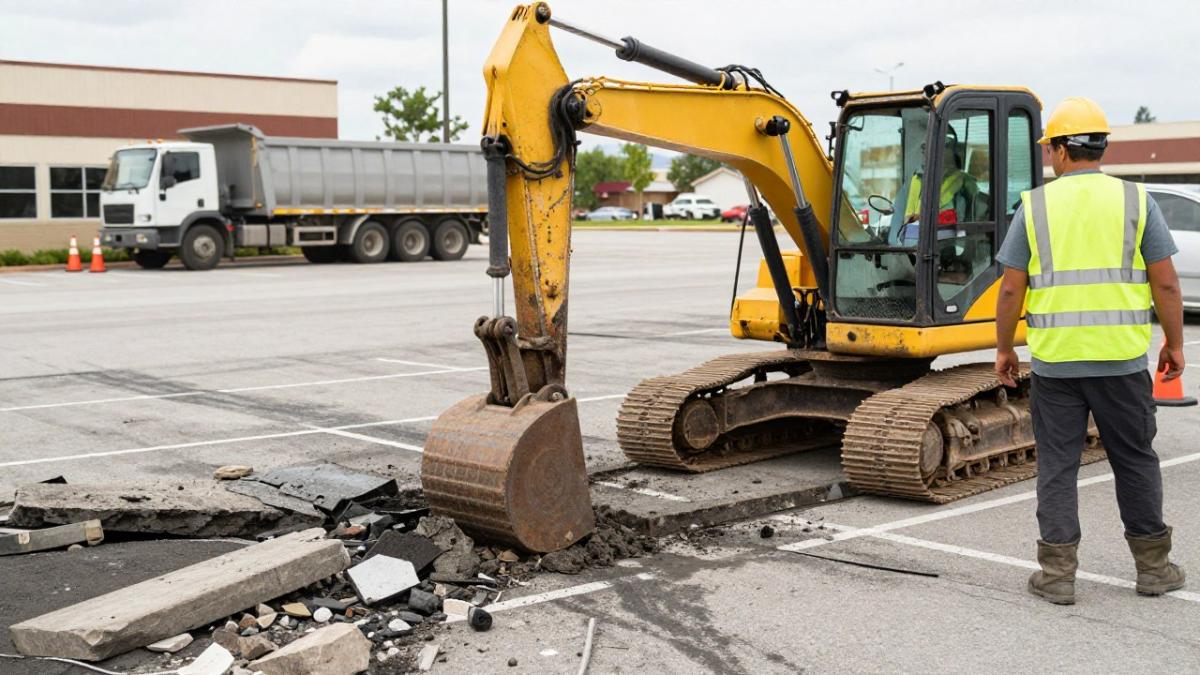
Mobilization day is mostly logistics. Crews deliver equipment, set barricades and temporary signage, mark the phase footprint, and confirm utility locates are complete. Saw-cutting follows, then removal of the existing pavement. Expect heavy truck traffic and dust. Millings and broken concrete leave the site by dump truck, so coordinate the haul route with neighboring businesses and confirm the contractor has a dust-control plan. If the lot serves a retail or medical tenant, schedule demolition for the lowest-traffic days and post the phase map at every entrance.
Week 1 to Week 2: Subgrade and Base Repair
Once pavement is off, the unknown begins. Crews proof-roll and grade the exposed subgrade, then excavate failed areas down to stable soil. Aggregate base is placed in lifts, with compaction testing between lifts. This is the phase most likely to trigger a change order, because base failures are invisible until demolition exposes them.
Week 2: Drainage, Utilities, and Curb Work
Drainage improvements, catch basin repairs, inlet adjustments, pipe replacement, and re-grading to positive slope, usually happen before paving so the finished surface drains correctly. Curb, gutter, and accessible-ramp work is also sequenced here. Confirm that temporary accessible routes remain usable and that inlets are protected from sediment during the rest of the work. If your lot has a stormwater permit, this is when erosion and sediment controls get inspected.
Week 2 to Week 3: Paving and Rolling
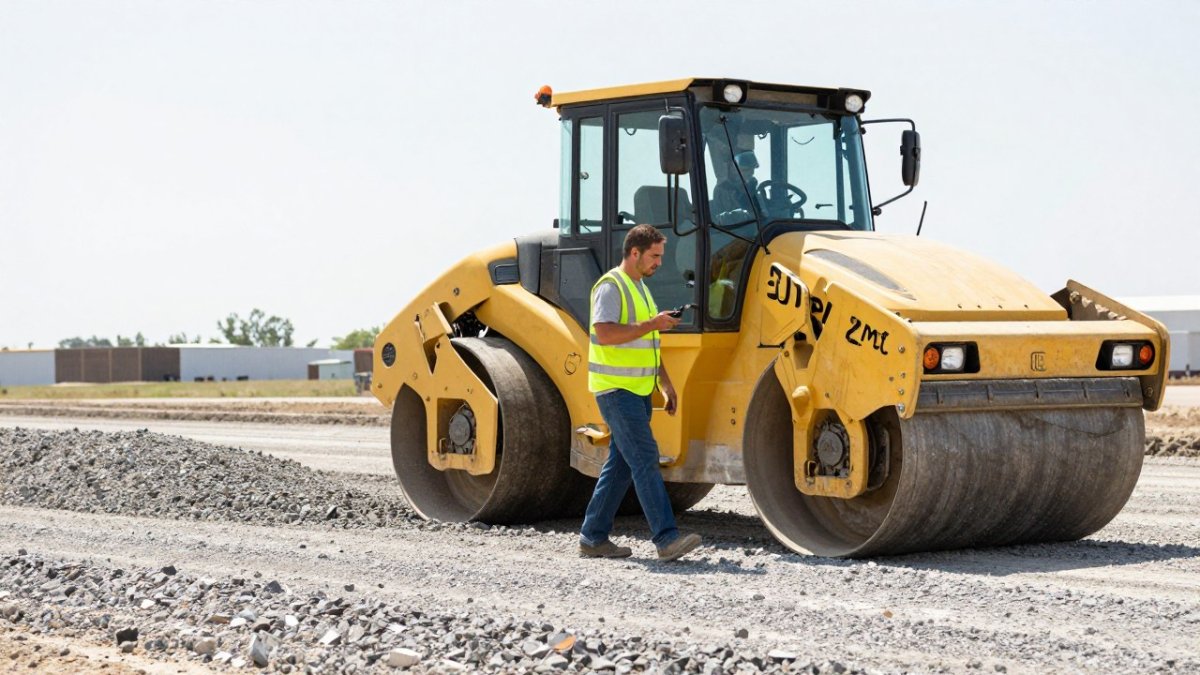
Paving is weather-dependent. Paving is weather-dependent, and cold, rain, or high wind can push the paving day. Crews place asphalt in lifts, then compact with rollers while the mix is still hot. Thickness and compaction are verified by coring or density testing. Fresh asphalt must cool before traffic returns, usually a matter of hours for surface courses, longer in cool weather. Heavy trucks and loaded delivery vehicles should stay off until the surface has stiffened.
Week 3: Cure, Striping, and Reopening
Asphalt does not “cure” the way concrete does; it stiffens as it cools, and it continues to gain strength over days and weeks. Striping usually follows paving by a day or more so paint does not track. Final walkthrough, punch-list items, and closeout documentation come last. Reopening is phased: the first section may reopen while the last section is still being striped.
What Actually Drives the Schedule
A common pattern is that the schedule slips not because crews are slow but because weather, base condition, and inspection availability intervene. Rain stops excavation and paving; cold slows compaction and curing; an unexpected base failure adds days; a failed compaction test means rework. Build weather float into the contract, get delay communication terms in writing, and ask for a milestone schedule rather than a single completion date.
Parking Lot Resurfacing vs Reconstruction: Which One Does Your Lot Need
The choice between parking lot resurfacing and reconstruction comes down to what is failing. Resurfacing, also called an overlay, adds a new asphalt layer over sound pavement. Reconstruction removes and rebuilds the pavement structure, including the aggregate base and subgrade. If the distress is confined to the surface, an overlay can work. If the base has failed, an overlay only hides the problem for a season or two.
| Method | What It Addresses | Best For | Watch Out For |
|---|---|---|---|
| Sealcoating | Surface oxidation, minor cracks | Preventive maintenance on sound pavement | Hides nothing structural |
| Resurfacing (overlay) | Surface wear, shallow cracking | Lots with intact base | Reflects base failures quickly |
| Full-depth reconstruction | Failed base, subgrade, drainage | Structural failure, ponding, rutting | Higher disruption and cost |
Parking Lot Project Phasing and Traffic Management: Keeping the Lot Open
Phasing keeps a commercial lot usable during reconstruction by dividing it into sections, but phasing only works when it is designed before the first shovel hits the ground. A workable plan assigns each phase a defined footprint, a temporary traffic pattern, and a reopening date. Parking lot project phasing and traffic management also covers the unglamorous details: barricades, signage, striping of temporary aisles, and coordination with delivery trucks and ADA parking.
What most guides miss is that tenants tolerate disruption when they know the schedule. Post the phase map in common areas and send it to every tenant contact.
Parking Lot Reconstruction Checklist: What Owners Should Prepare
Preparation before the contractor arrives prevents most day-one delays. Use this parking lot reconstruction checklist, and treat the communication items as seriously as the physical ones, most tenant complaints trace back to surprise, not to the work itself.
Vehicles, Staging, and Site Access
- Confirm permits are issued and posted, and that any pre-construction meeting with the site inspector is scheduled
- Clear the staging area of vehicles, dumpsters, and stored materials; tow or relocate vehicles before mobilization day
- Confirm utility locates are complete and marked
- Identify temporary ADA parking and accessible routes, and verify they connect to an accessible entrance
- Arrange alternate access for deliveries and trash pickup, and notify haulers of the new route
- Document existing conditions with dated photos, including pavement, curbs, drainage inlets, and landscaping
Communication and Notice Periods
Give tenants and employees advance notice of each phase closure. Post the phase map in common areas, send it to every tenant contact, and designate a single point of contact for questions. For retail and medical tenants, coordinate with each business on its peak hours so phased closures do not land on its busiest days. Watch out: if notice goes only to the property owner and not to tenants, the contractor will arrive to a lot full of cars and the schedule will slip on day one.
Phased Closures and Alternate Entrances
Phasing only works when each phase has a defined footprint, a temporary traffic pattern, and a reopening date. Mark temporary aisles and keep fire lanes clear, and confirm that accessible routes and spaces remain available during each phase. Coordinate delivery windows with the contractor so trucks are not routed into a closed section.
Records, Permits, and Stakeholder Notifications
- Gather drainage records, prior repair invoices, and any warranty documents for the contractor’s review
- Confirm stormwater permit coverage and erosion-control responsibilities in writing
- Notify your insurer and confirm coverage during construction
- Notify neighboring businesses of the haul route and heavy-truck hours
- Confirm the change-order process and who has authority to approve one
- Schedule a pre-mobilization walkthrough with the contractor and the site inspector
What to Have Ready on Day One
Have the signed contract, the milestone schedule, the phase map, the tenant contact list, and the single point of contact’s phone number in one place. Confirm the contractor has the compaction testing plan and material specifications in hand. If you are still selecting a contractor, our guide on how to hire a paving contractor for your small business walks through vetting.
Signs Your Parking Lot Needs Reconstruction, Not Another Patch
Patching treats symptoms. Reconstruction addresses causes, and the signs that you need the latter are usually structural. Alligator cracking across a wide area, recurring potholes in the same spot, rutting in travel lanes, and ponding that never drains all point to a failed base or subgrade. If patches keep failing within a season, the pavement structure is the problem, not the surface.
For a deeper look at the warning signs, read our guide on signs your parking lot needs reconstruction.
How Long Parking Lot Reconstruction Takes and What Delays It
Parking lot reconstruction duration depends on factors such as weather and base condition. Rain stops excavation and paving; cold slows curing; unexpected base failures add days. A common mistake is treating the schedule as fixed when the base is unknown until demolition exposes it. Build weather float into the contract and get delay communication terms in writing.
Evaluating Bids and Verifying Quality Before You Sign
Bids are not comparable line by line unless you know what sits behind each number. Ask every bidder for the pavement section design, material sources, compaction testing, and a schedule with milestones. Verify quality by requesting compaction test results and material documentation, and confirm the contractor owns or controls the equipment needed rather than subcontracting the critical work. Comparing cost drivers helps you spot a low bid that skips base repair; our breakdown of commercial parking lot repair cost factors explains what drives the quote.
Accessibility and Stormwater Rules That Apply During Reconstruction
Accessibility and stormwater compliance do not pause for construction. The Americans with Disabilities Act standards for accessible design require accessible routes and parking to remain available, so temporary ADA spaces and paths must be planned, not improvised. Stormwater rules under the EPA’s stormwater program govern erosion control, sediment tracking, and drainage during construction. Grading must preserve or improve drainage so water leaves the lot instead of ponding. Confirm both items are in the contractor’s plan before mobilization.
Getting a Quote for Your Parking Lot Reconstruction
A useful quote starts with a site assessment, not a phone estimate. Expect the contractor to walk the lot, core or probe the base, review drainage, and document existing conditions before pricing. Ask what the quote includes and excludes, how change orders are handled, and what the warranty covers. If you are still selecting a contractor, our guide on how to hire a paving contractor for your small business walks through vetting.
When you are ready to move, contact our team to schedule an assessment and get a written quote. For help building your schedule around the work, see our guide on planning an asphalt paving project timeline.
Reconstruction disrupts your lot, your tenants, and your revenue, and the difference between a smooth project and a stalled one is usually preparation and communication. All-Tech Asphalt Paving, LLC. provides reconstruction services using specialized excavation machinery, an owned fleet of concrete mixer trucks, and materials that meet or exceed state and federal standards. Get started with All-Tech Asphalt Paving, LLC. and move from failing pavement to a lot that holds up for years.
Frequently Asked Questions
How long does parking lot reconstruction take?
A full parking lot reconstruction typically runs several weeks to a few months depending on lot size, base condition, drainage work, and weather. The parking lot reconstruction timeline includes mobilization, demolition, subgrade and base repair, paving, curing, and striping. Ask your contractor for a phase-by-phase schedule so you can plan access around it.
Can a parking lot stay open during reconstruction?
Often, yes, through parking lot project phasing and traffic management. Contractors divide the lot into sections so one area is under construction while others stay usable. You may lose a portion of spaces temporarily and need to redirect traffic with cones, signage, and barricades. For very small lots, a short full closure may be simpler. Discuss phasing early so the contractor can sequence demolition and paving around your busiest hours.
What is the difference between parking lot resurfacing and reconstruction?
Resurfacing, or an overlay, adds a new layer of asphalt over existing pavement that is still structurally sound. Reconstruction removes the old pavement down to the subgrade, repairs the base, and installs new asphalt or concrete. If your lot has deep cracking, rutting, potholes, or drainage issues, resurfacing alone may fail quickly. A site assessment and engineering evaluation will tell you which approach your pavement structure actually needs.
How long should you wait before driving on newly paved asphalt?
Heavy vehicles and full loads should wait until the surface has set, and your contractor will give a specific reopening time based on curing conditions. Your contractor will give a specific reopening time based on curing conditions. Avoid parking heavy trucks on fresh asphalt in hot weather, and keep line striping crews off the surface until it has set. Follow the contractor’s written guidance for the safest result.
What factors can delay a parking lot reconstruction project?
Rain and wet subgrade are the most common delays, because base layers and fresh asphalt need dry conditions. Other factors include utility conflicts, undiscovered base failures, permit approvals, material delivery, and temperature limits for paving. A good contractor builds weather days into the schedule and communicates changes promptly. Ask how delays are handled and who notifies tenants or customers when the schedule shifts.
How should a business prepare for parking lot reconstruction?
Use a parking lot reconstruction checklist: notify tenants and employees of the schedule, arrange temporary parking, plan delivery and trash pickup routes, confirm ADA accessibility paths, and secure permits. Move signage and protect landscaping near the work zone. Also ask the contractor for proof of insurance, a written scope, and material documentation. Preparation before mobilization reduces confusion and keeps your operation running during construction.
