
How to Verify Asphalt Material Quality Before It Goes Down
Last Updated: November 6, 2026
Quick Summary
To verify asphalt material quality, collect representative samples from the plant silo and behind the paver, compare lab results against the approved mix design, and confirm density with field tests and cores. Knowing how to verify asphalt material quality means checking binder content, gradation, temperature, and compaction at every stage before the mat goes down.
- Pull at least three random samples per lot from the plant silo and behind the paver, never from the top of the pile.
- The approved mix design should list binder grade and content, aggregate gradation, target air voids, and mixing temperatures.
- Density is reported as a percentage of laboratory maximum theoretical density or a control-strip density, with limits set by project specifications.
- When a lot falls below the density lower limit, check mix temperature, roller passes, rolling pattern, and lift thickness before re-testing.
- Simple field checks include infrared temperature readings, watching for bleeding spots and segregation, and confirming lift thickness against the plan.
Table of Contents
- Step 1: Collect Representative Samples and Review the Mix Design
- Step 2: Match Asphalt Testing Methods to the Project Stage
- Step 3: Confirm Asphalt Density Testing in the Field
- Step 4: Read the Asphalt Testing Laboratory Report
- Step 5: Run Asphalt Quality Control Checks Non-Specialists Can Do
- Request Material Documentation for Your Next Paving Quote
- Frequently Asked Questions
Step 1: Collect Representative Samples and Review the Mix Design
Learning how to verify asphalt material quality starts long before the first roller touches the mat, and this guide shows you how to verify asphalt material quality at every stage. This guide walks through the checks that separate a durable pavement from a premature failure. Asphalt quality verification is the process of sampling, testing, and comparing a plant-produced mix against its approved mix design before and during placement.
You cannot test what you did not sample correctly.
Sampling at the Plant and Behind the Paver
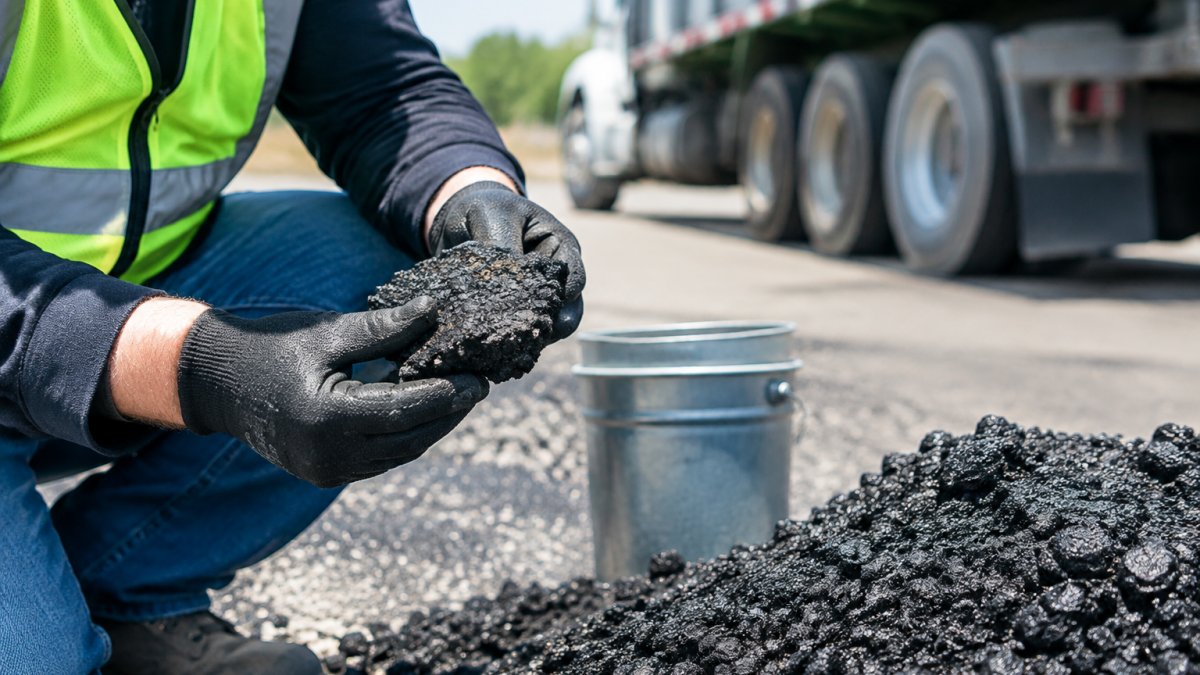
Pull samples from two places: the plant silo and the mat behind the paver. Plant samples show what the supplier produced. Paver samples show what actually went down. Grab at least three random locations per lot, never from the top of the pile. Scoop from the full depth of the material and combine the portions in a clean bucket. Label each sample with the date, location, and mix type.
What the Mix Design Should Show You
The mix design is the recipe the plant must follow. Ask for the current, approved design before work begins. It should list:
- Asphalt binder grade and content
- Aggregate gradation and stockpile sources
- Target air voids and compaction requirements
A common mistake is accepting an old design that was never updated for a new aggregate source. Watch out: if the gradation on the design does not match the aggregate delivered to the plant, the mix will not perform as designed.
Step 2: Match Asphalt Testing Methods to the Project Stage
Different stages call for different tests. Skipping a stage means problems surface later, usually as cracking or rutting. The table below pairs each stage with the right check.
| Project Stage | Test or Check | What It Confirms |
|---|---|---|
| Pre-production | Mix design verification | Recipe meets spec |
| Plant production | Binder content, gradation | Consistent mix |
| Laydown | Temperature, thickness | Proper placement |
| Post-compaction | Density, cores | Achieved compaction |
Tests for Binder, Aggregate, and Asphalt Content
The asphalt testing laboratory runs three core checks on plant-produced mix. The extraction test separates binder from aggregate so you can measure asphalt content (D2172/D2172M Standard Test Methods for Quantitative Extraction of Asphalt Binder from…). Gradation analysis shakes the dried aggregate through sieves to confirm the size blend. If you are weighing which materials hold up best, see our guide on the best asphalt paving materials for durability.
Step 3: Confirm Asphalt Density Testing in the Field
Asphalt density testing is the single best predictor of pavement life. Under-compacted mix traps air, and trapped air lets water in. Water plus traffic equals cracking and rutting.

How Density Is Measured and What the Number Means
Density is reported as a percentage of the laboratory maximum theoretical density (often called Rice density or Gmm) or as a percentage of a control-strip density.
A nuclear gauge emits low-level radiation and counts particles to estimate density in place (Pavements). A non-nuclear gauge uses electrical impedance or a mechanical impulse method. Both are fast and non-destructive, which is why they are used for process control across a lot.
Test Frequency and Random Location
Test at random locations across each lot, not just the easy spots. Record every reading against its station. A reading that swings wildly from its neighbors signals a problem with the rolling pattern or the mix itself.
Use a random-number method to pick stations rather than walking to the middle of the mat. Edge and joint locations are where density usually falls short, so include them deliberately in the sampling plan rather than letting them be avoided.
Reading a Failing Density Result
When a lot falls below the lower limit, do not simply re-test until a passing number appears. First check the obvious causes: mix temperature at laydown, roller type and pass count, rolling pattern, lift thickness, and whether the mat cooled before compaction.
Watch out: a single high reading next to a cluster of low ones usually means the gauge was placed on a segregated spot, not that the lot passed, verify with a core before accepting it.
Step 4: Read the Asphalt Testing Laboratory Report
A lab report is only useful if you can read it. Each result should list the test method, the measured value, and the specification limit. Compare the measured value to the limit line by line.
Acceptance Criteria and Specification Interpretation
Acceptance criteria are the pass-or-fail limits written into the project specifications. A result inside the limit passes. A result outside it fails, even by a small margin.
Most specifications also define a tolerance band and a consequence, a pay adjustment, a required re-test, or removal and replacement. Read the consequence before you read the result, so you know whether a marginal number is a warning or a rejection.
Variability, Re-Testing, and Troubleshooting
Every test has measurement variation. A single result near the limit line is not proof of a problem, and a single result well inside the limit is not proof of quality.
When a result is out of tolerance, the follow-up sequence is: confirm the sample was representative and properly labeled, confirm the test method and calibration, then re-test a duplicate from the retained sample.
Step 5: Run Asphalt Quality Control Checks Non-Specialists Can Do
You do not need a lab to catch obvious problems. For a deeper look at what poor quality leads to, read how to prevent premature asphalt failure.
- Check the temperature with an infrared gun at laydown
- Look for shiny, bleeding spots on the mat
- Watch for segregation, where coarse stone clusters together
If the mat looks patchy or the temperature drops too low before rolling, stop and ask questions. It is cheaper to fix a problem at the paver than to mill it out a year later.
Request Material Documentation for Your Next Paving Quote
Ask every paving quote for the mix design, the plant tickets, and the lab results before you sign. Ask any supplier for these documents before you sign. At All-Tech Asphalt Paving, LLC., our materials meet or exceed all state and federal standards, and we follow strict manufacturer specifications on every job. If you are still weighing contractors, our guide to choosing a paving company covers what to ask. Ready to move? Contact our team to request material documentation and a quote.
Frequently Asked Questions
How do you check asphalt quality?
Quality checks combine plant and field verification. At the plant, review the mix design and sample plant-produced mix for asphalt content, aggregate gradation, and binder consistency. In the field, measure density and compaction with a gauge or cores, check thickness, and compare results against the project specifications. A complete asphalt quality control report ties the samples, test results, and acceptance criteria together so any failing lot is caught before more pavement goes down.
How is asphalt density tested in the field?
Two common approaches are nuclear and non-nuclear density gauges, which read density in place within seconds, and core sampling, where cores are cut and measured in a lab for bulk specific gravity. Gauges let crews test many spots quickly; cores give a more definitive result for acceptance. Both should be taken at random locations across the mat, not just where the roller passed most, and compared against the target density in the specifications.
Which tests are used to verify asphalt mix quality?
Common asphalt testing methods include extraction and gradation analysis to confirm asphalt content and aggregate gradation, penetration and viscosity tests for binder consistency, Marshall stability and flow for deformation resistance, and performance tests for rutting and cracking. Density and compaction tests verify the placed mix. The tests your project actually requires depend on the specifications, so read those first and match the test list to the acceptance criteria.
Can you judge asphalt quality by its appearance?
Appearance catches obvious problems, not material quality. A uniform, well-compacted mat with straight joints and no segregation is a good sign, but a smooth surface tells you nothing about binder content, aggregate gradation, or in-place density. Those require sampling and lab testing. Treat a visual walk-through as a field check that flags issues for testing, not as proof the asphalt meets specifications.
Verifying asphalt quality is not glamorous work, but it is the difference between a lot that lasts and one that fails early. If you want a paving partner who documents every material decision and stands behind the result, All-Tech Asphalt Paving, LLC. is ready to help. We bring high-quality materials, strict specification compliance, and a schedule you can count on. Get started with All-Tech Asphalt Paving, LLC. and build a pavement that holds up for the long haul.
